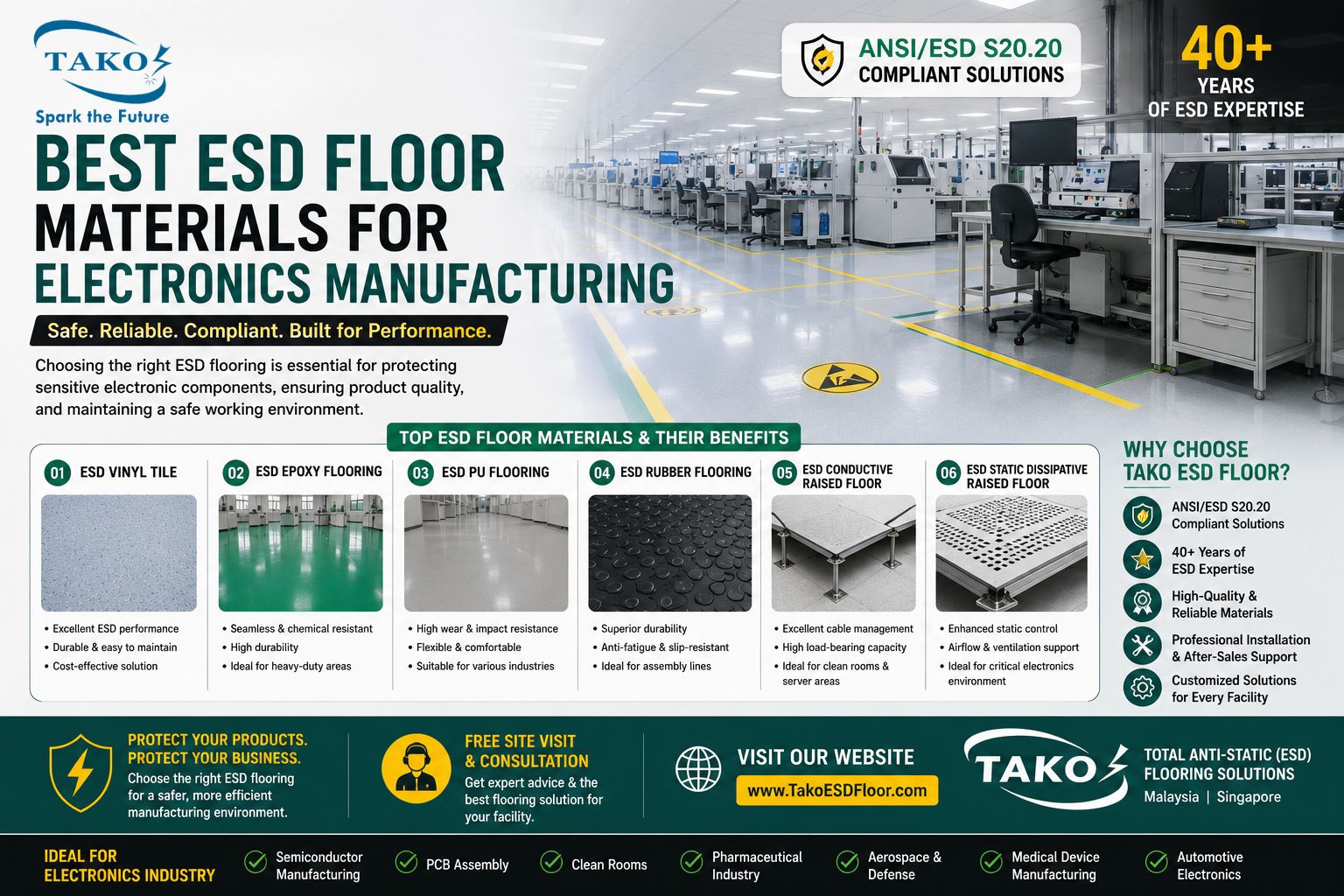
TAKO since 1979: Protecting Sensitive Electronics through Understanding Static Control Malaysia.

Understanding Static Control Malaysia begins in the fast-paced corridors of “Silicon Island” in Penang and the bustling industrial hubs of the Klang Valley, where a silent predator lurks within the production lines. Electrostatic Discharge (ESD) is often invisible and unfelt, yet it remains one of the most significant causes of component failure in the electronics industry. For manufacturers striving for excellence, Understanding Static Control Malaysia is no longer just a technical requirement—it is a survival strategy for high-tech longevity.
Since the late 1970s, Malaysia has grown into a global powerhouse for semiconductor assembly and testing. As components have shrunk in size, their sensitivity to static has increased exponentially, making the precision of Understanding Static Control Malaysia more critical than ever before. This is where the heritage of TAKO since 1979 becomes invaluable. With over four decades of hands-on experience, we have witnessed the evolution of technology and the corresponding need for sophisticated defense mechanisms against static electricity.
Table of Contents
2. The Science of Static: Why Control is Non-Negotiable
To truly master Understanding Static Control Malaysia, one must first understand the physics of the problem. Static electricity is generated through tribocharging—the contact and separation of materials. In a manufacturing environment, this happens every time a worker walks across a floor, picks up a plastic tray, or moves a circuit board.
Malaysia’s tropical climate presents a unique challenge. While high humidity can naturally help dissipate some static, it is a common misconception that humidity alone is a sufficient control measure. In climate-controlled cleanrooms where humidity is strictly regulated to prevent corrosion or mold, the air can become dry enough to facilitate massive static build-ups. Understanding Static Control Malaysia means recognizing that reliance on the weather is a recipe for disaster.
The financial impact of ESD is staggering. Industry estimates suggest that up to 33% of product losses in semiconductor manufacturing are attributable to static-related events. These aren’t just immediate “catastrophic failures” where a part stops working instantly; the more dangerous threat is the “latent defect,” where a component is weakened and fails only after it has been shipped to the end customer.
3. Key Components of an Effective ESD Protected Area (EPA)
To build a truly effective defense, your facility must move beyond basic precautions. Understanding Static Control Malaysia involves creating a synchronized environment where every element—from the air to the floor—works together to eliminate charge.
Here is a deeper look at the three pillars of a high-standard Electrostatic Protected Area (EPA):
1. Surface Control: The Foundation of the EPA
In the context of Understanding Static Control Malaysia, the “surface” is your first line of defense. A standard table or floor acts as a reservoir for static; however, an ESD-safe surface acts as a highway to the ground.
- Conductive vs. Dissipative: TAKO since 1979 designs surfaces with specific resistance levels. Conductive surfaces move charges almost instantly, while dissipative surfaces drain the charge more slowly to prevent a sudden “spark” that could melt a microchip’s internal circuits.
- The Grounding Chain: It is not enough to have an ESD mat; that mat must be physically connected to the building’s common ground point. Without this connection, the mat simply holds the charge, waiting to discharge into the next sensitive component that touches it.
2. Personal Grounding: Managing the Human Element
Humans are “static generators.” Simply walking across a room or shifting in a chair can generate thousands of volts. Understanding Static Control Malaysia requires a “zero-tolerance” approach to personal grounding.
- The Wrist Strap System: This is the most common way to ground seated personnel. A high-quality strap from TAKO since 1979 includes a current-limiting resistor (usually $1$ megohm) for operator safety, ensuring that while static is drained, the worker is protected from accidental electrical shocks.
- ESD Footwear and Flooring: For mobile workers, the floor-to-footwear system is critical. The shoe must have a conductive path that connects the person’s skin to the ESD floor. If the floor is dirty or the shoes are non-compliant, the circuit is broken, and the worker becomes a walking ESD hazard.
3. Ionization: Controlling the Un-groundable
There are some materials that simply cannot be grounded, such as plastic carriers, tape, or glass. These are insulators. Through Understanding Static Control Malaysia, we solve this using ionization.
- Neutralizing the Air: Ionizers work by using high voltage to “split” air molecules into positive and negative ions. These ions are then blown across the workspace. When they encounter a charged insulator, the opposite ions are attracted to it, neutralizing the static charge in seconds.
- Total Environment Coverage: TAKO since 1979 recommends overhead ionizers for large work areas and ionizing blow-off guns for targeted cleaning. This ensures that even the most “stubborn” static-prone materials are rendered safe before they come near sensitive electronics.

4. Materials Matter: Understanding Static Control Malaysia Standards
In the technical world of ESD prevention, precision in terminology is the difference between a protected component and a costly failure. Understanding Static Control Malaysia requires a deep dive into the electrical resistance of materials to determine how they interact with static charges.
Here is a detailed breakdown of the material classifications and the global standards that govern them:
1. Anti-Static: Preventing the “Spark” at the Source
“Anti-static” is often used as a catch-all term, but in professional circles, it refers to materials that resist tribocharging (the generation of static through friction).
- How it works: These materials are usually treated with a topical agent that keeps them “slick” at a molecular level, preventing a charge from building up when the material is rubbed or handled.
- The Limitation: While they don’t create much static, they are poor at removing static that is already there. For example, a “pink poly” bag is anti-static; it won’t shock your component, but it won’t shield it from an external electrical field either.
- TAKO since 1979 Insight: We often recommend anti-static materials for non-critical areas or short-term consumables where “low-charging” properties are sufficient.
2. Static Dissipative: The “Gold Standard” for EPAs
For most electronics manufacturing in Malaysia, dissipative materials are the preferred choice for work surfaces and garments.
- Resistance Range: These materials have a surface resistance between $10^6$ and $10^11$ ohms.
- Controlled Discharge: The beauty of dissipative material is that it allows a static charge to flow to the ground, but it does so slowly. This is crucial because an instantaneous discharge (a spark) can create high heat that destroys sensitive circuits. Dissipative materials “bleed” the energy away safely.
- Long-Term Reliability: Through Understanding Static Control Malaysia, TAKO since 1979 has developed dissipative polymers where the antistatic properties are embedded into the material, ensuring they don’t “wash off” or diminish over time.
3. Conductive: Rapid Energy Transfer
Conductive materials have a very low electrical resistance (typically less than $10^6$ ohms).
- The Speed of Grounding: Because electrons move through these materials with almost no resistance, they are excellent for floor mats or grounding bins where you want the charge gone immediately.
- The Safety Factor: While highly effective, conductive materials must be used carefully. If an operator touches a live electrical circuit while standing on a highly conductive floor, the risk of a severe electrical shock is higher. This is why Understanding Static Control Malaysia includes balancing conductivity with operator safety resistors.
4. Navigating Global Standards: ANSI/ESD S20.20 and IEC 61340
To operate in the global market, Malaysian manufacturers must speak the international language of compliance.
- ANSI/ESD S20.20: This is the primary standard used in North America and largely adopted in Malaysia. It provides the administrative and technical requirements for establishing an ESD control program.
- IEC 61340: This is the international equivalent, often used by European partners.
- The Role of TAKO since 1979: Achieving compliance isn’t just about buying a mat; Malaysian standard it’s about verification. We provide the testing equipment (surface resistance meters, megohmmeters) and the certified materials required to pass an audit.

5. Common ESD Pitfalls in Malaysian Manufacturing
While having the right equipment is a great start, the effectiveness of any ESD program is only as strong as its weakest link. In many Malaysian factories, the failure isn’t the product—it’s the application. Understanding Static Control Malaysia requires identifying and eliminating these common industrial oversights.
Here is an in-depth analysis of the most frequent pitfalls and how to avoid them:
1. The “Human Element”: Knowledge vs. Compliance
You can purchase the most expensive flooring and workstations, but if your personnel are not disciplined, your ROI will be zero.
- The Training Gap: Many workers view ESD protocols as “extra work” rather than a critical manufacturing step. Without a deep Understanding Static Control Malaysia, an operator might tuck their ESD smock sleeves into standard gloves or forget to test their wrist strap at the start of a shift.
- The “Tethered” Fallacy: A common mistake is assuming that a wrist strap protects a worker when they stand up to reach for a tool. The moment that cord is unclipped, the worker becomes a static generator. TAKO since 1979 emphasizes a dual-grounding approach: wrist straps for seated work and ESD footwear/flooring for any movement.
- Maintenance Neglect: ESD equipment wears out. Wrist strap coils lose continuity and floor surfaces get coated in non-conductive wax. Understanding Static Control Malaysia includes a rigorous schedule of daily, weekly, and monthly testing to ensure the “Human Element” remains grounded.
2. Packaging Confusion: Shielding vs. Anti-Static
Perhaps the most dangerous pitfall is the misuse of ESD packaging. Not all “colored bags” provide the same protection.
- The “Pink Poly” Trap: Pink polyethylene bags are “anti-static,” meaning they won’t create a charge when rubbed against other bags. However, they have no shielding properties. If a charged person touches the outside of a pink bag, the static charge will pass straight through to the component inside.
- The Faraday Cage Effect: Truly protecting sensitive electronics during transit requires Static Shielding Bags (usually silver/metallized). These create a “Faraday Cage” that conducts the charge around the exterior of the bag, leaving the contents untouched.
- Understanding Static Control Malaysia means knowing the “Internal vs. External” rule: Use dissipative bins or pink poly inside the EPA, but always use shielding bags when moving components outside the protected zone.
3. Cleaning and Chemical Interference
Even a perfect ESD floor can be “killed” by the wrong cleaning crew.
- Insulative Residue: Standard floor waxes and household detergents are designed to create a shiny, protective coating. In an ESD environment, this coating is an insulator. It acts as a barrier between the worker’s shoe and the conductive floor.
- Understanding Static Control Malaysia necessitates the use of ESD-safe floor finishes and cleaners provided by specialists like TAKO since 1979. These chemicals are engineered to clean without leaving behind a non-conductive film, maintaining the floor’s resistance within the required $10^6$ to $10^9$ ohm range.
4. Ignoring the “Static Field”
Sometimes, the threat isn’t a direct touch, but a nearby field.
- Process-Essential Insulators: Items like plastic clipboards, standard clear tape, and even some computer monitors generate massive static fields. If a sensitive circuit board is placed too close to these items, a “field-induced” discharge can occur.
- The Solution: Understanding Static Control Malaysia involves “shadowing” the production line to identify these insulators and either replacing them with ESD-safe versions or installing targeted ionization to neutralize the field.

6. The Strategic ROI: Benefits of Mastering Static Control Malaysia
Investment in static control is often viewed as an expense, but it is actually a high-yield investment.
- Yield Improvement: By reducing ESD events, factories see an immediate spike in “First Pass Yield.”
- Cost Reduction: The cost of one high-end microchip can often pay for an entire year’s supply of ESD consumables.
- Global Competitiveness: To win contracts from international tech giants, Malaysian SMEs must prove their commitment to Understanding Static Control Malaysia.
7. Material Science: Selecting Certified Static Control Solutions
The materials used in 1979 are not the same as those used today. Modern ESD polymers are engineered at the molecular level. TAKO since 1979 has been at the forefront of this R&D, holding over 30 patents in the field.
Understanding Static Control Malaysia technicalities means evaluating the “decay time” of a material—how long it takes for a 1,000V charge to drop to 100V. In high-speed assembly lines, a material that takes too long to dissipate a charge is essentially useless. Our products are designed specifically to handle the high-throughput demands of modern manufacturing.

8. The TAKO Advantage: Since 1979
Why have we lasted 45 years? Because we don’t just sell products; we provide solutions. Our “ESCAPE” program (ElectroStatic Control And Prevention Engineering) is a testament to our deep-rooted philosophy of Understanding Static Control Malaysia. We conduct site audits, provide technical training, and manufacture the very items we recommend.
From the first cleanroom bags developed in the 1980s to the advanced ionizers of the 2020s, TAKO since 1979 has been a partner to Malaysia’s industrial growth. We understand the local nuances—the heat, the humidity, and the high expectations of the Malaysian workforce.
9. Checklist: Is Your Facility Truly Protected?
Before you conclude that your facility is safe, ask yourself:
- Are your ESD floors tested monthly using a megohmmeter?
- Do all visitors wear heel grounders before stepping into the EPA?
- Is Understanding Static Control Malaysia a core part of your new-hire orientation?
- Are you using “shielding” bags for external transport?
- Is your ionizer balance checked regularly?
10. Conclusion: Future-Proofing Your Production Lines
As we move into the era of Industry 4.0 and 5G technology, the components we build will only become more sensitive. The margin for error is shrinking. Understanding Static Control Malaysia is the key to ensuring that Malaysian manufacturing remains world-class.
At TAKO since 1979, we remain dedicated to this mission. We invite you to look at your production floor not just as a place of work, but as a precision environment that requires the highest level of protection. By prioritizing Understanding Static Control Malaysia, ESD standards in Malaysian you are protecting your assets, your reputation, and your future.
Disclaimer
Disclaimer: The information provided in this blog is for educational purposes only and is based on industry standards at the time of writing. While TAKO since 1979 strives for accuracy, electrostatic discharge (ESD) requirements can vary based on specific manufacturing environments, local regulations, and component sensitivity. Readers are advised to consult with a certified ESD professional or contact TAKO directly for a comprehensive site audit and tailored solutions. TAKO Astatic Technology Sdn Bhd shall not be held liable for any damages resulting from the use or misuse of the information provided herein.
Frequently Asked Questions
Why is Understanding Static Control Malaysia so important for new factories?
New factories often use the latest, most sensitive equipment. Without Understanding Static Control Malaysia, these expensive machines can be damaged during installation or initial calibration.
Can I use standard cleaning chemicals on my ESD floor?
No. Standard waxes or cleaners can create an insulative layer over the floor. To maintain the integrity of Understanding Static Control Malaysia, you must use specialized ESD-safe cleaners.
Does TAKO since 1979 provide training for staff?
Yes. Part of our commitment to Understanding Static Control Malaysia includes professional training sessions for engineers and floor operators to ensure compliance and safety.
How does humidity specifically impact Understanding Static Control Malaysia?
High humidity helps, but in the dry, air-conditioned environments required for precision manufacturing, static can still build up on surfaces. Understanding Static Control Malaysia requires active measures regardless of the outdoor weather.
What is the lifespan of an ESD floor installed by TAKO since 1979?
With proper maintenance and a solid Understanding Static Control Malaysia protocol, our floors are designed to last 10-15 years while maintaining their conductive properties.