TAKO Since 1979: Stop Static Damage with Our ESD Flooring Guide Malaysian Manufacturers

ESD flooring guide Malaysian manufacturers rely on starts with a single, undeniable truth: in the high-precision world of semiconductor and medical device assembly, what you can’t see will absolutely destroy your bottom line. Since the late 1970s, Malaysia has evolved into a global powerhouse for high-tech manufacturing, but this industrial transformation has brought a silent, microscopic enemy to the factory floor—Electrostatic Discharge (ESD).
At TAKO Since 1979, we don’t just see static electricity as a nuisance; we treat it as a “silent killer” of modern innovation. Imagine an operator walking across a non-compliant floor; with every step, they generate a massive triboelectric charge. Without a scientifically engineered path to ground, that stored energy sits like a loaded spring, waiting to discharge into your most sensitive—and expensive—components.
This is precisely why a comprehensive ESD flooring guide Malaysian manufacturers trust is no longer a luxury—it is a functional necessity for maintaining peak yield, global compliance, and a flawless professional reputation. Since 1979, we have been the first line of defense for Malaysia’s tech giants, proving that total protection begins from the ground up.
Table of Contents
2. The Physics of Static: Why Standard Floors are “Silent Killers”
To understand why this ESD flooring guide Malaysian manufacturers follow is so critical, one must understand the physics of the floor. Standard epoxy or vinyl floors are insulators. They “trap” electrons on the surface. When friction occurs—such as a trolley wheel rolling or a person walking—thousands of volts are generated.
In Malaysia’s unique tropical climate, humidity levels fluctuate. While high humidity can sometimes dissipate static, EOS/ESD Association, Inc., modern cleanrooms are strictly climate-controlled and often very dry. This dryness increases the risk of high-voltage sparks. TAKO Since 1979 has engineered flooring solutions that work regardless of the ambient humidity, providing a consistent “drain” for static electricity. Any ESD flooring guide Malaysian manufacturers read should emphasize that “Anti-Static” is not the same as “ESD-Safe.” You need a floor that is actively conductive or dissipative to meet global audit requirements.
3. Economic Impact: The Real Cost of ESD Failures for Manufacturers
Why is an ESD flooring guide Malaysian manufacturers can implement so valuable? Because the cost of failure is astronomical. If a semiconductor plant in Penang or a medical device facility in Kulim experiences even a 5% failure rate due to static discharge, it translates to millions of Ringgit in lost revenue and wasted materials annually.
TAKO Since 1979 has helped countless firms realize that the Return on Investment (ROI) for quality ESD flooring is measured in months, rather than years. By following this ESD flooring guide Malaysian manufacturers can avoid the following four critical financial and operational pitfalls:

Eliminating the “Silent Killer”: Latent Defects
One of the most dangerous aspects of static is the “latent defect.” This occurs when an ESD event weakens a component without destroying it immediately. The product passes your internal quality control and is shipped to the customer, only to fail weeks or months later in the field. TAKO Since 1979 provides the shielding necessary to prevent these “walking wounded” components, saving your brand from catastrophic field failures and expensive recalls.
Drastic Reduction in Scrap and Rework Costs
Every time a PCB (Printed Circuit Board) is damaged by static, the cost isn’t just the component itself; it’s the energy, labor, and machine time already invested in that unit. By implementing the standards found in this ESD flooring guide Malaysian manufacturers can significantly lower their “scrap rate.” Reducing waste directly inflates your bottom line and ensures your production line runs at maximum efficiency.
Protection of Brand Equity and Customer Trust
In the global supply chain, a manufacturer’s reputation is their most valuable currency. If your facility consistently ships products that fail due to poor ESD management, international clients will move their contracts elsewhere. Using the ESD flooring guide Malaysian manufacturers trust—and partnering with a pioneer like TAKO Since 1979—signals to your global partners that you adhere to the highest levels of quality and technical discipline.
Meeting Global Audit and Compliance Standards
To secure high-value contracts from multinational corporations (MNCs), your facility must pass rigorous audits like ANSI/ESD S20.20 or IEC 61340. These certifications are impossible to achieve with standard flooring. Following the technical specifications provided by TAKO Since 1979 ensures that your floor isn’t just a surface, but a certified grounding system that meets international export requirements, keeping you competitive in the global market.
4. The Technical Guide to ESD Flooring Materials
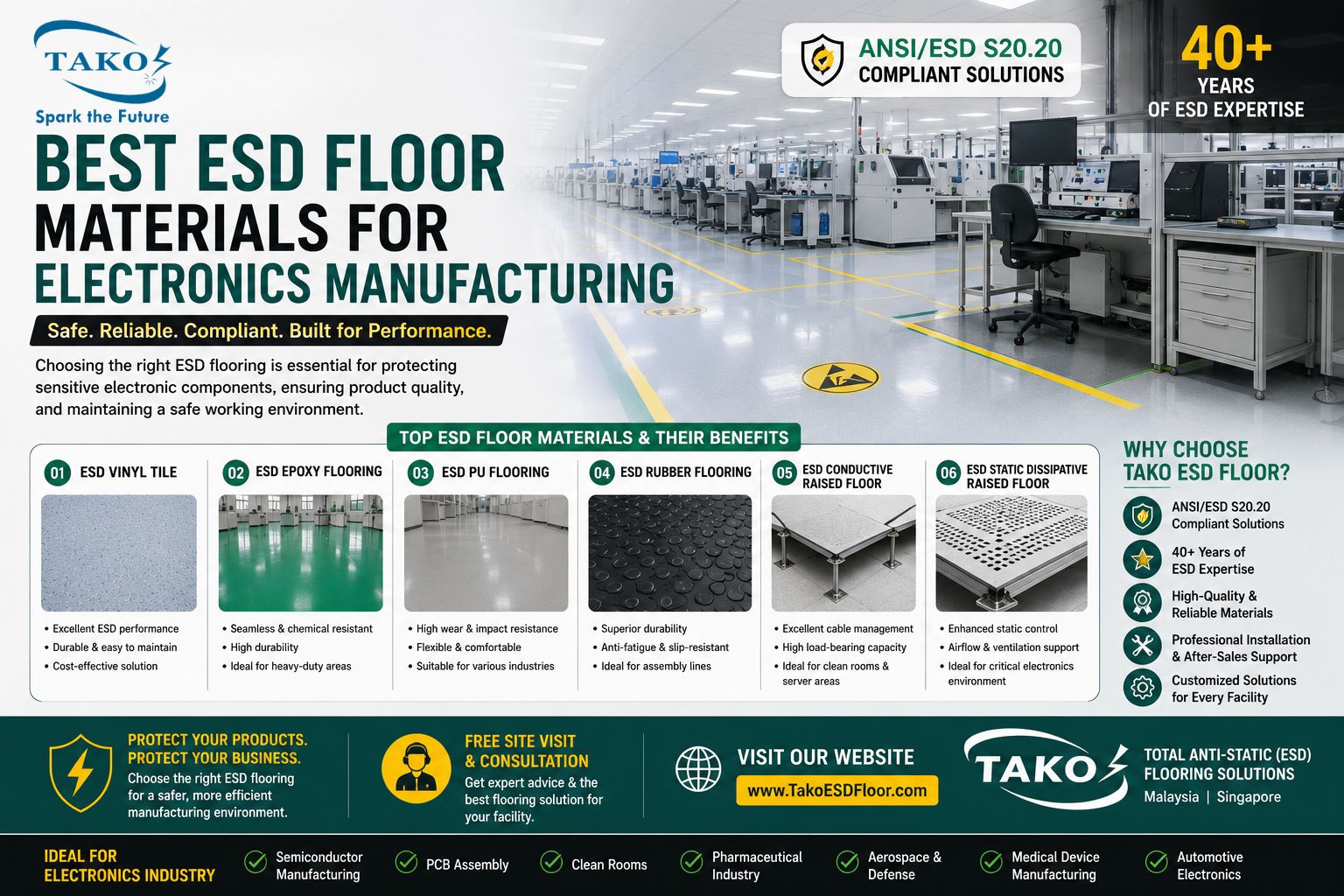
In this ESD flooring guide Malaysian manufacturers will find three primary material choices, each engineered to solve specific industrial challenges. Selecting the right material is not just about the surface; ESD Flooring Solutions, it is about matching the physical durability of the floor with the electrical sensitivity of your components.
TAKO Since 1979 has spent decades refining these material applications to suit the tropical climate and high-output demands of local factories. Here is a deeper look at your primary options:

ESD Vinyl (PVC) Tiles: The Precision Standard for Cleanrooms
ESD Vinyl remains the most popular choice for high-tech cleanrooms across Malaysia. These tiles are engineered with a consistent carbon-veined structure that provides permanent static dissipative or conductive properties. Unlike coatings, the ESD protection is embedded throughout the entire thickness of the tile, meaning the electrical performance will never “wear off.”
- Chemical Resistance: TAKO Since 1979 provides vinyl that withstands common industrial solvents and cleaning agents used in sterile environments.
- Low Outgassing: Essential for ISO-certified cleanrooms where air purity is as critical as static control.
- Modular Advantage: If a small area is damaged by heavy machinery, individual tiles can be replaced without resurfacing the entire floor, saving significant maintenance costs.
ESD Epoxy Coatings: Seamless Strength for Heavy Industry
For large-scale warehouses and manufacturing plants where heavy trolleys, forklifts, and AGVs (Automated Guided Vehicles) are in constant motion, ESD Epoxy is the superior choice. This resin-based system creates a seamless, non-porous finish that bonds directly to the concrete substrate.
- Seamless Hygiene: Because there are no joints or seams, there is nowhere for dust or contaminants to hide, making it ideal for pharmaceutical and medical device assembly.
- Impact Durability: This material is designed to handle high-impact loads and abrasive wear without cracking, which is a common failure point in standard flooring.
- Aesthetic Versatility: TAKO Since 1979 offers epoxy in various colors, allowing manufacturers to use color-coding to designate “ESD Protected Areas” (EPAs) clearly.
Dissipative vs. Conductive: Engineering the Resistance Range
This is a crucial technical distinction in any ESD flooring guide Malaysian manufacturers should note. The choice between these two depends entirely on the speed at which you need to “drain” static from your operators and equipment.
- Conductive Flooring : These floors have very low electrical resistance, meaning they move electrons to the ground almost instantly. This is vital in environments with highly sensitive explosives, flammable gases, or ultra-sensitive electronics where even a micro-second delay in discharge could be catastrophic.
- Dissipative Flooring : These floors offer a “slower,” more controlled flow of electricity. This is often preferred in general electronic assembly because it provides a layer of safety for the human operators, preventing a rapid “shock” while still effectively removing static before it can harm a component.
TAKO Since 1979 helps you analyze your specific assembly requirements to ensure you don’t over-specify (wasting budget) or under-specify (risking component damage). By following this ESD flooring guide Malaysian manufacturers can ensure their material choice aligns perfectly with their operational goals.
5. Engineering the Grounding System: It’s Not Just a Surface
A floor is only an ESD floor if it is connected to the earth. This ESD flooring guide Malaysian manufacturers follow stresses the “under-the-hood” components. Beneath the TAKO Since 1979 tiles lies a network of copper foil strips. These strips are connected to the building’s electrical ground.
Without this copper grid, the static has nowhere to go. TAKO Since 1979 ensures that the conductive adhesive used is of the highest grade, creating a permanent bond that facilitates electron flow. Any ESD flooring guide Malaysian manufacturers consult must explain that the floor is a system, not just a tile.
6. Navigating International Standards: ANSI/ESD S20.20 and IEC 61340
For Malaysian manufacturers, exporting to the US or Europe requires strict compliance. This ESD flooring guide Malaysian manufacturers rely on highlights ANSI/ESD S20.20. This standard requires regular testing of the floor-to-ground resistance.
TAKO Since 1979 products are tested to meet these international benchmarks. When an auditor visits your plant, having a TAKO Since 1979 floor provides peace of mind. This ESD flooring guide Malaysian manufacturers use as a reference ensures you are always “audit-ready.”
7. Why Experience Matters: The TAKO Since 1979 Story
45+ Years of Local Environmental Expertise
Malaysia’s tropical climate presents unique challenges for static control. High humidity can fluctuate rapidly between the monsoon seasons and the bone-dry, air-conditioned environments of a Grade 100 cleanroom. TAKO Since 1979 understands these local atmospheric variables better than any international competitor. Our ESD flooring guide Malaysian manufacturers use is specifically calibrated for the Malaysian climate, ensuring that your floor’s electrical resistance remains stable 365 days a year, regardless of the weather outside.

Immediate Technical Support and Local Logistics
In a high-output manufacturing environment, downtime is the enemy. If you have a technical question or need an urgent facility expansion, TAKO Since 1979 is right here in your backyard. You won’t have to wait for overseas consultants or deal with international shipping delays for replacement materials. By following the ESD flooring guide Malaysian manufacturers prefer, you gain access to a local supply chain that ensures your production lines never stop moving due to a flooring issue.
A Legacy of Evolving with Industry Standards
We have seen the industry shift from basic anti-static requirements to the rigorous, multi-layered demands of ANSI/ESD S20.20 and IEC standards. Because we have been here since the beginning, our ESD flooring guide Malaysian manufacturers follow isn’t just a static document; it’s a living history of technical evolution. We don’t just sell you what worked in 1979—we provide the cutting-edge conductive and dissipative technologies required for the sub-nanometer components of the future.
Relationship-Driven “Zero-Static” Culture
We aren’t just selling a floor; we are sharing an ESD flooring guide Malaysian manufacturers have used for generations to build global success. At TAKO Since 1979, we believe in a partnership model. We provide on-site training for your maintenance teams and conduct periodic resistance testing to ensure your facility remains in peak condition. Our success is measured by your facility’s yield and your ability to pass every audit with flying colors.
8. Installation Excellence: Avoiding Common Pitfalls
Installation is where many projects fail. This ESD flooring guide Malaysian manufacturers follow emphasizes substrate preparation. In Malaysia, concrete floors often retain moisture. If you install ESD tiles over wet concrete, the adhesive will fail.
TAKO Since 1979 professional installers perform moisture tests before a single tile is laid. We ensure the copper grid is perfectly flat and the grounding points are secure. A poorly installed floor is a safety hazard; following the ESD flooring guide Malaysian manufacturers trust ensures a perfect finish every time.
9. Maintenance & Lifecycle Management
The “Never-Wax” Mandate: Protecting Conductivity
Standard commercial floor waxes are designed to create a high-gloss, protective plastic film. While this looks beautiful in a retail mall, in a high-tech factory, that film acts as a dielectric barrier. It blocks the path to ground, rendering your ESD shoes and grounding straps useless. TAKO Since 1979 provides specialized ESD-safe floor finishes that enhance the shine without compromising the ohms resistance levels required by your auditors.
Using pH-Neutral, ESD-Safe Detergents
Not all soaps are created equal. Harsh industrial degreasers can strip the conductive elements from the surface of your tiles or epoxy. The ESD flooring guide Malaysian manufacturers follow specifies the use of pH-neutral cleaners that lift dirt and oils while leaving the conductive carbon matrix intact. Our TAKO Since 1979 approved cleaning solutions are designed to prevent “insulative film buildup,” ensuring that every square inch of your floor remains a reliable “drain” for static electricity.
Avoiding Contamination and “Insulative Dust”
In the busy industrial corridors of Malaysia, dust and debris from outside can be carried into the “ESD Protected Area” (EPA). If this dust is non-conductive, it creates a microscopic layer of insulation between the operator’s shoe and the floor. TAKO Since 1979 emphasizes a rigorous sweeping and vacuuming schedule using HEPA-filtered equipment. Maintaining a “Cleanroom Standard” of cleanliness is the only way to ensure the ESD flooring guide Malaysian manufacturers rely on actually works in real-time production.
Periodic Verification and Resistance Auditing
A floor that “looks” clean may not be “electrically” clean. As part of the ESD flooring guide Malaysian manufacturers use for ISO compliance, we recommend periodic testing using a Surface Resistance Meter. TAKO Since 1979 offers professional auditing services where we measure Point-to-Point (Rpp) and Point-to-Ground (Rtg) resistance. These tests prove that your maintenance team is doing their job correctly and that your facility is still providing 100% protection to your sensitive electronic components.

10. Conclusion: Securing Your Manufacturing Future
In summary, static control is not optional—it is a foundational requirement for modern industry. This ESD flooring guide Malaysian manufacturers have read today outlines the path to a safer, more profitable facility.
Since TAKO Since 1979 began its journey, our goal has remained the same: to provide the most reliable static control solutions in the region. By utilizing this ESD flooring guide Malaysian manufacturers can rest assured that their sensitive components are protected by the best in the business.
Don’t let static damage your reputation. Use the ESD flooring guide Malaysian manufacturers have trusted for over 40 years. Contact TAKO Since 1979 today to begin your journey toward a zero-static environment. Our ESD flooring guide Malaysian manufacturers love is just the beginning of what we can offer.
Frequently Asked Questions
Can ESD flooring be installed over existing tiles?
Yes, provided the surface is level and properly prepared according to the ESD flooring guide Malaysian manufacturers follow
How often should we test our floor’s resistance?
TAKO Since 1979 recommends monthly internal checks and annual professional audits.
Does this ESD flooring guide Malaysian manufacturers use apply to small workshops?
Absolutely. Static doesn’t care about the size of your facility; protection is always necessary.
Where can I find the best ESD flooring guide Malaysian manufacturers recommend?
You are reading it right now, provided by the experts at TAKO Since 1979.