
TAKO since 1979: Perak Industrial Park ESD Solutions

Picture this: a state-of-the-art electronics manufacturing facility in the heart of a Perak industrial park. The production lines are humming, orders are being fulfilled, and on the surface, everything is running smoothly. Yet, a hidden, silent threat is at work. Products are failing quality checks at an inexplicable rate. Field returns are creeping up. A major international client is questioning your reliability. The culprit? Not poor workmanship or subpar materials, but an invisible force—Electrostatic Discharge, or ESD.
For the thriving electronics and high-tech manufacturing sectors in Perak, from the automotive electronics hubs in Tanjung Malim to the growing tech presence in Kamunting, ESD is not a theoretical risk; it’s a multi-million ringgit operational reality. Implementing robust Perak industrial park ESD solutions is no longer a secondary consideration but a fundamental pillar of quality control, profitability, and global competitiveness.
This blog is designed to be your definitive resource. We will demystify ESD, break down the essential components of an effective protection system, and provide a step-by-step roadmap for implementation. Our goal is to equip facility managers, plant owners, and safety officers with the knowledge to build a world-class, resilient operation right here in Perak.
TAKO since 1979 has over 45 years of Experience in offering ESD Solutions in Malaysia and Singapore at Affordable Price.
Why ESD is a Critical, Costly Threat to Perak’s Manufacturing Ambitions
Perak is strategically positioning itself as a key player in Malaysia’s advanced manufacturing landscape. With investments flowing into sectors like semiconductor assembly, automotive electronics, and the production of Internet of Things (IoT) devices, the tolerance for product failure is vanishingly low. These modern components, built with nanoscale transistors, are incredibly sensitive. The same technological advancement that makes them powerful also makes them vulnerable to voltages that are imperceptible to humans.
What is ESD?
Electrostatic Discharge is the sudden flow of electricity between two electrically charged objects caused by contact, an electrical short, or dielectric breakdown. In a factory environment, this can happen in an instant—when a worker handles a circuit board, when a component slides down a conveyor, or even when a packaged product is placed on a shelf. The triboelectric effect, where certain materials become electrically charged after they are separated from a different material with which they were in contact (like a shoe sole lifting from a floor), is a primary generator of these damaging charges.
The damage falls into two categories:
- Catastrophic Failure: The component is destroyed immediately and rendered useless. This is the easiest type of failure to spot, as it fails quality control checks.
- Latent Defect: This is the more insidious and costly type of damage. The ESD event weakens or damages the component but does not immediately kill it. It passes inspection and is shipped to the customer, only to fail prematurely in the field. This leads to warranty claims, costly recalls, and irreparable damage to your brand’s reputation.
The financial implications are stark: scrap, rework, wasted labour, and lost customer trust. A single, undetectable ESD event can destroy a component worth thousands of ringgit. When multiplied across a production run, the losses can be staggering.
Furthermore, Perak’s tropical climate adds a unique layer of complexity. While high humidity can sometimes help dissipate static charge, it is not a reliable control method. In climate-controlled cleanrooms and production areas where humidity is managed for other process reasons, the ESD risk can actually be higher. This nuanced understanding of local environmental factors is a critical part of designing effective Perak industrial park ESD solutions. A one-size-fits-all approach imported from elsewhere simply will not suffice.
The Core Components of a Complete ESD Control Program
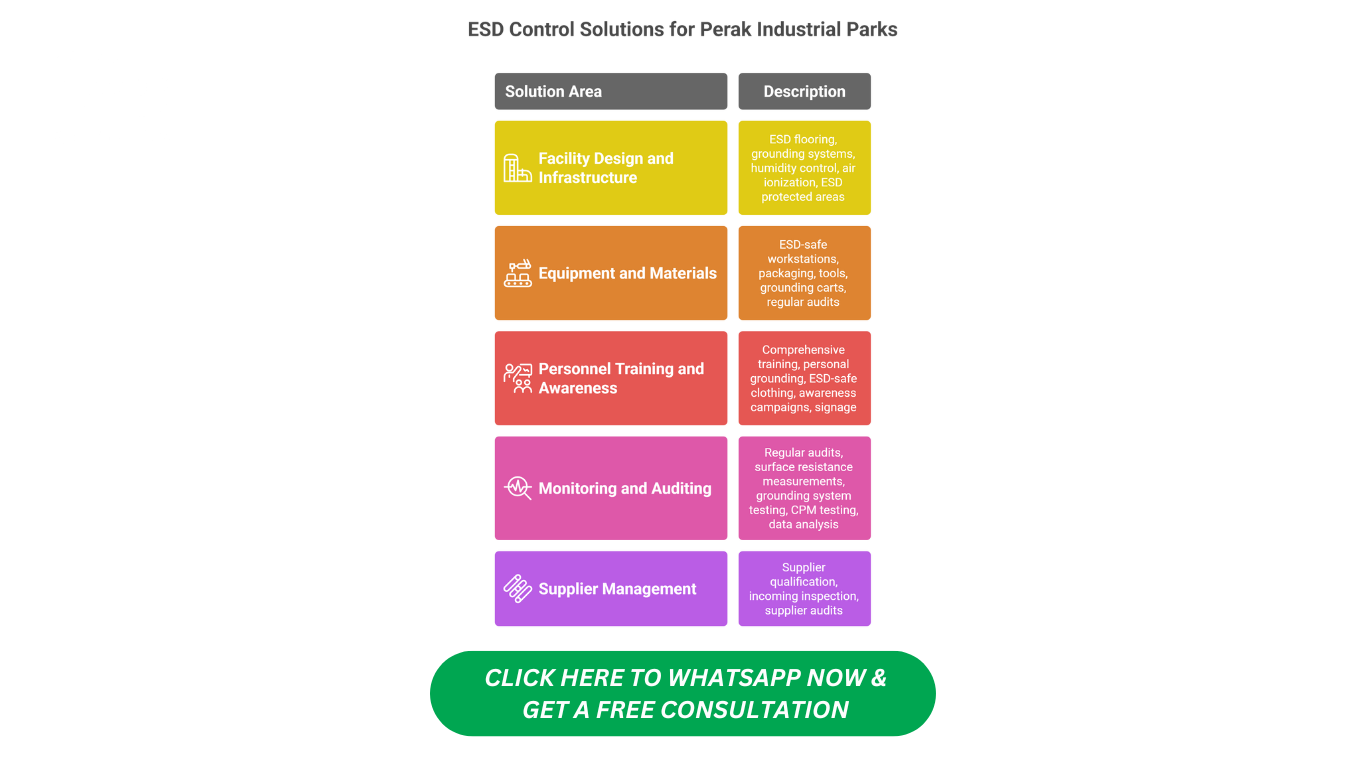
A successful ESD strategy is not about buying a few wrist straps. It is about creating a holistic, interconnected system where every element works in harmony to neutralize the threat. This is the foundation of all reliable Perak industrial park ESD solutions. Let’s break down the essential components.
1. The Foundation: ESD Protective Flooring and Work Surfaces
Everything begins with the foundation. The floors and workstations in your Perak facility form the first and largest defense perimeter.
- ESD Flooring: For any Perak industrial park ESD solutions project, selecting the right flooring is paramount. Options like conductive vinyl, static-dissipative epoxy coatings, or ESD tiles are designed to safely ground static charges from personnel and mobile equipment. The choice depends on your specific industry, traffic type, and cleanroom requirements. For instance, a heavy-duty epoxy floor might be ideal for an automotive electronics plant in Seri Iskandar, while a conductive vinyl might be better for a lighter-assembly facility.
- Work Surfaces: Every bench and table where sensitive components are handled must be an ESD-protective work surface. These are typically covered with static-dissipative mats that are properly grounded, providing a safe “home” for your products during assembly and testing.
2. The Lifeline: Personnel Grounding Systems
Your employees are the most common source of static generation. A comprehensive system for Perak industrial park ESD solutions must, therefore, focus on safely grounding every person who enters an ESD-Protected Area (EPA).
- Wrist Straps: The most recognizable element of ESD control. A properly worn and tested wrist strap is essential for personnel who are seated while handling sensitive components.
- Foot Grounding: For mobile workers, a combination of ESD footwear (shoes or heel straps) and ESD flooring is required. As workers walk, the system continuously drains static charges from their bodies to the ground.
- Continuous Monitoring: Relying on visual checks is unreliable. Modern Perak industrial park ESD solutions employ continuous monitoring systems that alert personnel and supervisors instantly if a wrist strap becomes disconnected or fails, ensuring 100% compliance in real-time.
3. Creating a Safe Zone: The ESD Protected Area (EPA)
An EPA is a defined space where all these elements come together to create a safe environment for handling ESD-sensitive items. Establishing an EPA is a core objective of any implementation of Perak industrial park ESD solutions.
- Boundary Definition: The EPA should be clearly marked, with access points controlled to ensure only properly grounded personnel and materials enter.
- Ionization: In areas where insulating materials (like certain plastics) cannot be eliminated, air ionization is a crucial tool. Ionizers neutralize static charges on these materials, preventing them from causing damage.
- Ancillary Equipment: Everything within the EPA must be considered. Shelving, carts, chairs, and tools must all be ESD-safe. Introducing a regular plastic bin or a non-compliant chair can compromise the entire system.
4. Handling and Packaging: The Final Defense Line
The protection cannot stop at the production line. Effective Perak industrial park ESD solutions extend to how components are stored, transported, and shipped.
- ESD-Safe Packaging: Shielding bags, conductive foam, and static-dissipative containers are designed to protect components from ESD events during internal logistics and when they leave your facility. Using the correct packaging is a final, critical step in the chain of custody.
A Step-by-Step Guide to Implementing Your ESD Program in Perak
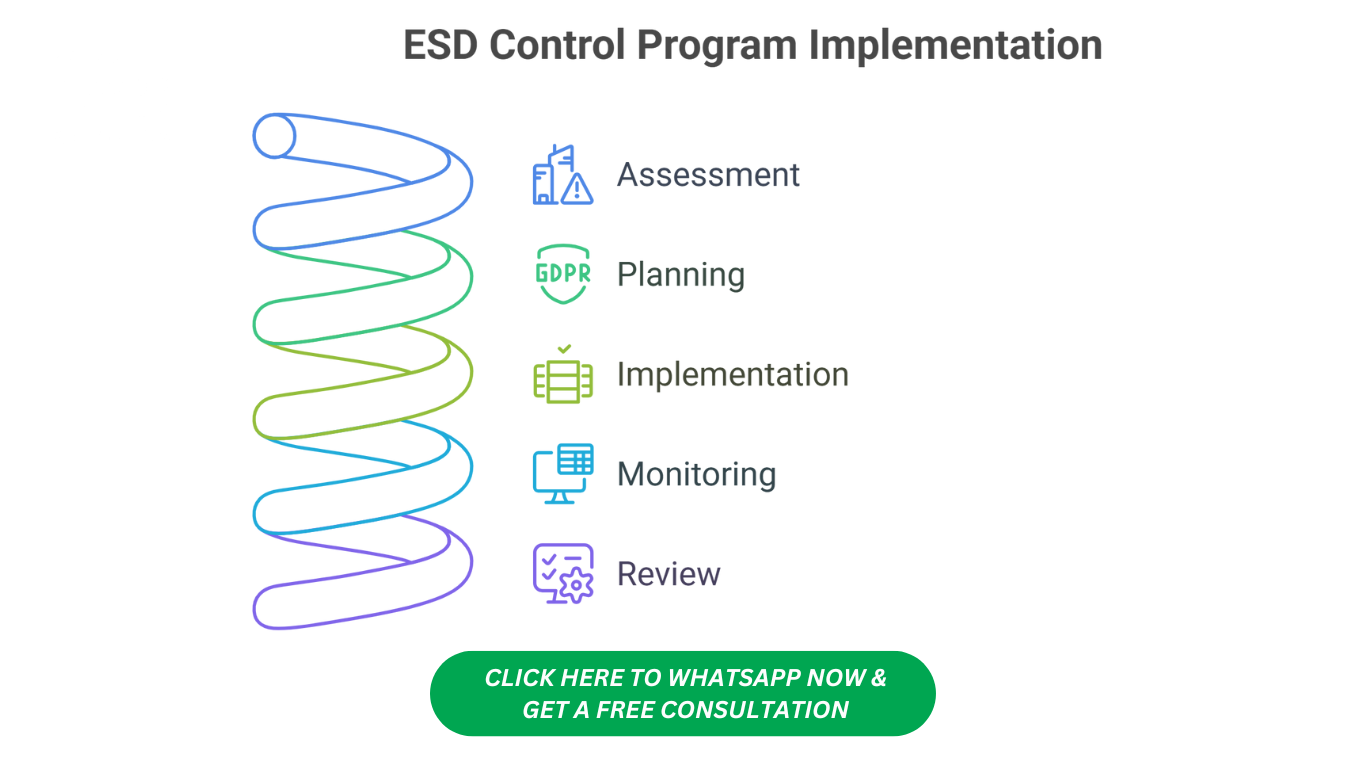
Knowing the components is one thing; implementing them effectively is another. Here is a practical, step-by-step guide tailored for businesses in Perak’s industrial parks.
Step 1: Conduct a Professional ESD Risk Assessment and Audit
You cannot fix what you don’t measure. Begin with a comprehensive audit of your entire facility by an ESD expert. This assessment will identify specific vulnerability points, measure static generation levels, and benchmark your current state against international standards like ANSI/ESD S20.20. This diagnostic phase is the most critical first step in developing tailored Perak industrial park ESD solutions.
Step 2: Develop a Formal ESD Control Plan
Based on the audit findings, draft a written ESD Control Plan. This document is your playbook. It should detail:
- The products and sensitivity levels you are protecting.
- The technical requirements for all ESD control items (flooring, wrist straps, etc.).
- Procedures for handling ESD-sensitive items.
- The limits for acceptable static charge.
Step 3: Invest in Employee Training and Foster an ESD-Aware Culture
Technology is useless without adherence. All personnel, from management to line operators, must understand the “why” behind the rules. Regular, engaging, and mandatory training sessions are non-negotiable. The goal is to move from enforced compliance to a genuine culture of quality where everyone is a guardian against ESD. This human element is what separates successful Perak industrial park ESD solutions from failed ones.
Step 4: Professional Installation and Verification
Once you have the plan and the team is trained, proceed with the professional installation of your ESD materials, particularly the flooring and grounding systems. After installation, do not assume it works. A crucial phase of implementing Perak industrial park ESD solutions is verification testing. Certified professionals should test the electrical resistance of the floors, the functionality of workstations, and the effectiveness of grounding systems to ensure they meet the specified parameters.
Step 5: Implement Ongoing Compliance Monitoring and Continuous Improvement
An ESD program is not a “set it and forget it” project. It requires vigilance. Schedule regular re-audits (semi-annually or annually) to check for degradation or new risks. Use continuous monitors at key workstations. Encourage a culture of reporting potential issues. This commitment to continuous improvement ensures your investment in Perak industrial park ESD solutions delivers long-term value.
The Tangible ROI: Why ESD Solutions are a Smart Investment for Perak
Some may view ESD control as a cost center. In reality, it is one of the highest-return investments a modern manufacturer can make. The business case for robust Perak industrial park ESD solutions is compelling and directly impacts your bottom line.
- Dramatically Reduced Scrap and Rework Rates: By preventing catastrophic and latent failures, you directly save on the cost of materials and labour wasted on defective products.
- Lower Warranty and Field Failure Costs: Shipping reliable products means a drastic reduction in expensive warranty claims, returns, and recall campaigns.
- Enhanced Brand Reputation and Customer Trust: In global supply chains, a reputation for flawless quality is your most valuable asset. Consistent, reliable performance makes you a supplier of choice.
- Compliance with International Standards: Meeting standards like ANSI/ESD S20.20 or IEC 61340-5-1 is often a prerequisite for supplying to multinational corporations. It opens doors to higher-value contracts and reinforces your company’s commitment to excellence.
When you frame it this way, the question is not “Can we afford to implement these Perak industrial park ESD solutions?” but rather, “Can we afford not to?”
Conclusion: Secure Perak’s Industrial Future, One Component at a Time
The journey to ESD competence is a strategic one. For the ambitious businesses operating within Perak’s industrial parks, it is a journey that directly aligns with the state’s vision for advanced, high-value manufacturing. By understanding the invisible threat of ESD and implementing a holistic, culture-driven control program, you are not just preventing losses—you are building a foundation of quality, reliability, and trust that will propel your business forward.
The complexity of designing and implementing effective Perak industrial park ESD solutions can be daunting, but you do not have to do it alone. Partnering with experts who have a proven track record in the Malaysian industrial context ensures your program is built on a solid foundation from day one.
Disclaimer
The information provided in this blog is intended for general informational purposes only. Prices, specifications, and availability may vary depending on suppliers, location, and market conditions. Readers should verify details directly with suppliers or manufacturers before making purchasing decisions. The author and website are not responsible for any errors, omissions, or outcomes resulting from the use of this information. Always consult a professional for advice tailored to your specific needs.
Frequently Asked Questions (FAQs)
What are the most critical first steps for implementing ESD solutions in a Perak factory?
The most critical first steps are a professional ESD risk audit and employee training. The audit will pinpoint your facility’s specific vulnerabilities within your Perak industrial park ESD solutions plan, while training ensures your team understands the “why” behind the protocols, creating a culture of quality from day one.
Is ESD flooring really necessary, or are wrist straps enough?
For a comprehensive Perak industrial park ESD solutions program, ESD flooring is essential. Wrist straps only protect components handled by a seated operator. ESD flooring works continuously to ground mobile personnel and equipment, creating a safe foundation throughout the ESD Protected Area (EPA).
How does Perak’s humid climate affect our ESD control strategy?
While high humidity can sometimes reduce static buildup, it is an unreliable control method. Air-conditioned production areas often have controlled, lower humidity, which increases ESD risk. Therefore, a robust, self-contained system of Perak industrial park ESD solutions—including flooring, grounding, and ionizers—is necessary regardless of the external climate.
Are there international standards we need to meet?
Yes, the most common international standard for ESD control is the ANSI/ESD S20.20. Compliance with this or similar standards (like IEC 61340-5-1) is often a mandatory requirement for supplying to global multinational corporations, making it a key goal for any Perak industrial park ESD solutions project.


