
TAKO since 1979: ANSI S20.20 ESD Work Chair

Have you ever shuffled your feet across a carpet and reached for a doorknob, only to be met with a sharp, surprising zap? That sudden spark is a vivid example of electrostatic discharge (ESD). Now, imagine that same tiny bolt of lightning, but it jumps from a technician’s finger onto a delicate circuit board inside a life-saving medical device or a cutting-edge smartphone. The result isn’t just a momentary shock; it’s often a catastrophic, invisible, and costly failure.
In the world of electronics manufacturing, assembly, repair, and research, the enemy is microscopic, silent, and carried on every person. This is where the humble office chair is no longer sufficient. It must be replaced by a critical piece of engineered equipment: the ESD Work Chair.
This comprehensive guide is designed to be your ultimate resource. We will delve deep into what an ESD Work Chair is, why it’s a non-negotiable asset in specific environments, and precisely how to select the right one. Our goal is to empower you with the knowledge to protect your investments, your productivity, and your bottom line. Choosing the correct ESD Work Chair is one of the most impactful decisions a tech-driven business can make.
TAKO since 1979 has over 45 years of Experience in offering ESD products including ESD Work Chair in Malaysia at Affordable Price.
What Exactly is an ESD Work Chair? (The “What”)
At its core, an ESD Work Chair is a specialized seating solution designed with one primary function: to safely control and dissipate static electricity from a person’s body to a grounded floor, thereby preventing a sudden, damaging discharge onto sensitive electronic components.
But how does it achieve this? It’s not magic; it’s materials science and engineering.
A standard office chair is typically constructed from insulating materials like plastic, nylon, and standard foam. These materials trap electrical charge, turning a person into a walking capacitor. When they reach for a sensitive component, the charge leaps across the gap.
An ESD Work Chair, in contrast, is built using conductive or dissipative materials.
- Conductive Materials: Have very low electrical resistance, allowing electrons to flow through them easily. These are often used in the chair’s casters and core frame components.
- Dissipative Materials: Have higher resistance than conductive materials, which allows them to control the rate at which static electricity is discharged. This slower, controlled discharge is often safer for the most sensitive components. These are typically used in the seat and backrest.
The entire construction of an ESD-safe chair creates a continuous, permanent path for static electricity to travel. The pathway looks like this:
Operator’s Body → Clothing → ESD Chair Surface (Seat/Back) → Conductive Frame → ESD Casters → ESD Flooring → Electrical Ground
Think of this system not as a barrier, but as a controlled highway. It gives static electricity a safe, direct, and predictable route to exit, completely bypassing your expensive electronic components. This fundamental principle is what separates a standard chair from a true ESD Work Chair.
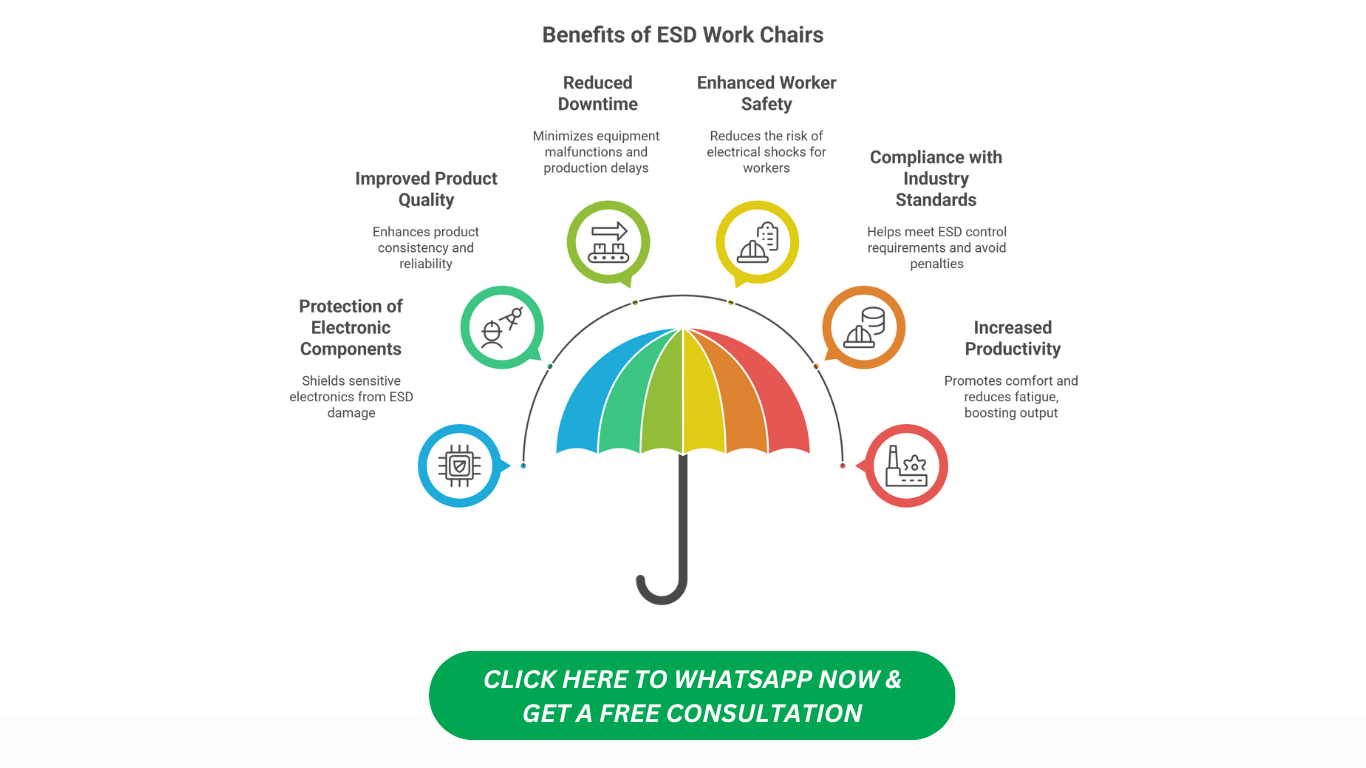
Why You Absolutely Need an ESD Chair: The High Stakes of Static
The need for a dedicated ESD Work Chair becomes crystal clear when you understand the devastating effects and hidden costs of uncontrolled ESD. Many failures are not dramatic explosions but subtle degradations that are far more insidious.
The Three Types of ESD Damage
- Catastrophic Failure: This is the easiest to spot. The electronic component is damaged so severely that it fails immediately and completely. While this is costly in terms of the lost component, it is at least detected at the inspection stage before it reaches a customer.
- Latent Defect: This is the true “silent killer” in electronics. A latent defect occurs when the ESD event only partially damages the component. It may still pass initial testing and function normally for days, weeks, or even months. However, the damage has weakened it, leading to a premature failure in the field. This is exponentially more costly, resulting in warranty claims, product returns, brand reputation damage, and potentially, in critical fields like medical or aerospace, dangerous situations.
- Upset Failure: This is a glitch or temporary malfunction in a device caused by ESD. The equipment isn’t permanently damaged but may reset, lose data, or behave erratically. While not destructive, it disrupts productivity and can be a sign of a vulnerable ESD control system.
The financial impact of these failures goes far beyond the cost of a single microchip. It includes:
- Scrapped materials and components
- Costly rework and labor
- Production line downtime
- Shipping and handling for returns
- Loss of customer trust and brand equity
Environments Where an ESD Work Chair is Essential
Any environment where unprotected people handle unprotected electronic components susceptible to ESD needs a comprehensive static control program, with a proper ESD Work Chair as a foundational element.
- Electronics Manufacturing and PCB Assembly: The epicenter of ESD sensitivity.
- Medical Device and Pharmaceutical Manufacturing: Where product reliability is directly tied to patient health.
- Aerospace and Automotive Electronics: A single latent failure can have dire consequences.
- Telecommunications and Data Centers: Ensuring the reliability of servers and network infrastructure.
- Research and Development Laboratories: Protecting prototypes and sensitive testing equipment.
- Repair and Rework Facilities: From smartphone repair shops to industrial PCB repair stations.
In these settings, relying on anything less than a certified ESD Work Chair is a significant and unnecessary risk. Furthermore, compliance with international standards like the ANSI/ESD S20.20, which provides a systematic approach to ESD control, often explicitly requires the use of grounded seating, making the right ESD Work Chair a matter of regulatory adherence.
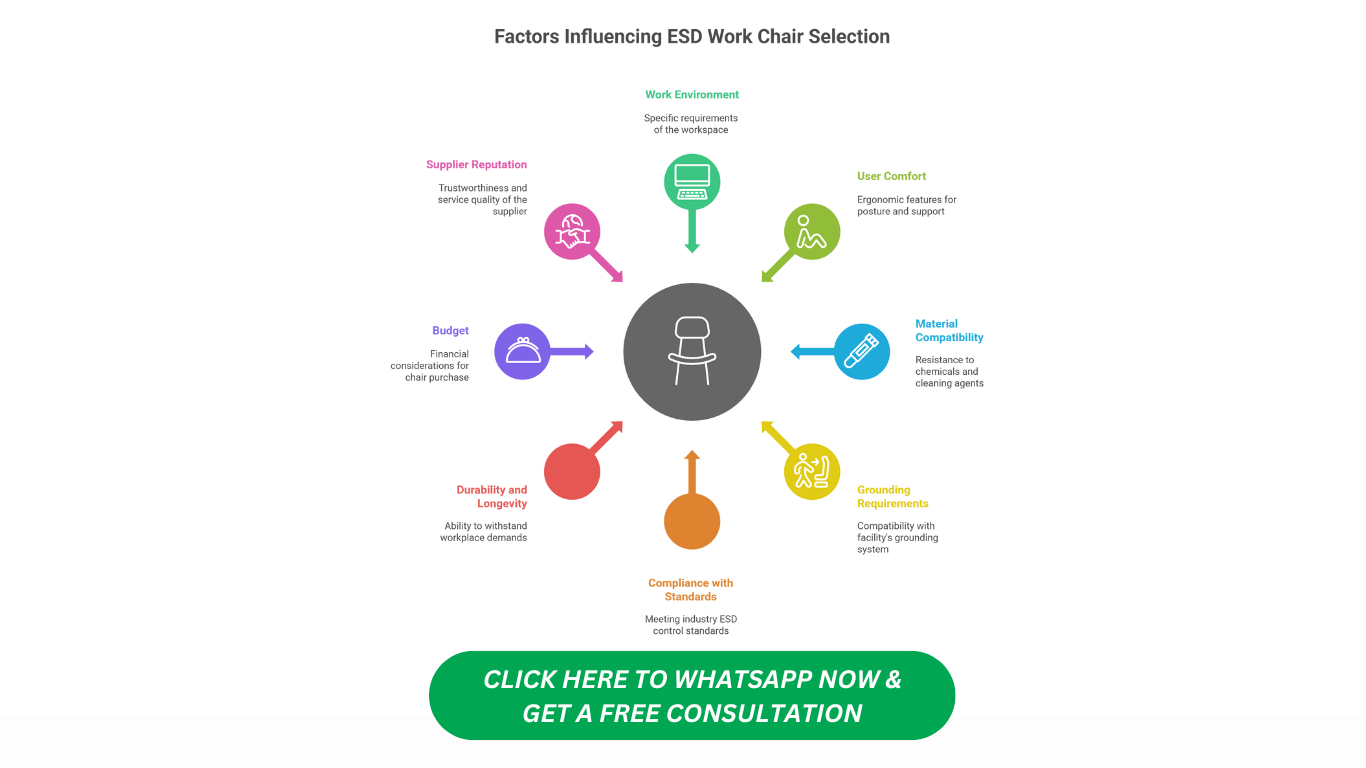
Key Features to Look For in Your Next ESD Work Chair
Selecting the right ESD Work Chair involves more than just verifying its ESD-safe properties. It’s an investment in both product protection and operator well-being. Here are the critical features to evaluate.
1. Material Construction: The Foundation of Safety
The entire ESD Work Chair must be part of the conductive path.
- Seat and Backrest: These are typically made from conductive or dissipative polyurethane foam and covered with a vinyl or fabric that is either carbon-loaded or treated to be static-dissipative. This ensures the static from the operator’s body is drawn into the chair.
- Armrests: If present, armrests must also be conductive. Look for models where the armrest caps are made from a static-dissipative material.
- Frame and Base: The internal metal structure is often coated with a special conductive epoxy paint or is itself made from a conductive material, ensuring the electrical path from the seat to the casters is unbroken.
2. Casters and Floor Contact: Completing the Circuit
This is a crucial and often overlooked component. The best ESD Work Chair in the world is useless if the static can’t get from the chair to the floor.
- ESD Casters: These are not standard casters. They are specially designed with conductive materials (often carbon-filled thermoplastic) in the wheels and forks. This allows the static electricity to flow through the caster to the ESD-protective flooring.
- Caster Shunts/Grounding Straps: Some models feature small, metal grounding straps (shunts) that drag lightly on the floor, ensuring a continuous electrical connection even if the chair is stationary. This provides a redundant path to ground, enhancing reliability.
Crucial Point: An ESD Work Chair is part of a system. It must be used in conjunction with ESD flooring—such as conductive vinyl tiles, epoxy flooring, or ESD carpet—to provide a complete path to the ground point. Using an ESD chair on a standard insulating carpet will break the circuit and render it ineffective.
3. Ergonomics and Adjustability: The Productivity Multiplier
An operator who is uncomfortable is less productive, more prone to error, and more likely to develop musculoskeletal disorders. In a high-precision environment, this is unacceptable. Therefore, a high-quality ESD Work Chair must also be a high-quality ergonomic chair.
Key ergonomic adjustments to look for include:
- Seat Height Adjustment: A pneumatic lever is standard and allows the user to position their feet flat on the floor with thighs parallel to the ground.
- Seat Depth Adjustment: This allows users with longer or shorter legs to ensure there is a 2-3 finger gap between the back of their knees and the seat pan, promoting circulation and reducing pressure.
- Backrest Height and Lumbar Support: The backrest should support the natural curve of the spine, with adjustable lumbar support to prevent lower back strain.
- Adjustable Armrests: Height-adjustable, and ideally pivot-adjustable, armrests allow the user to support their forearms, reducing strain in the shoulders and neck during intricate work.
- Tilt and Tension Control: A synchro-tilt mechanism allows the seat and backrest to recline together, promoting movement and blood flow throughout the day.
Investing in an ergonomic ESD Work Chair is an investment in human capital. It reduces fatigue, minimizes the risk of repetitive strain injuries, and keeps your highly skilled workforce focused and efficient.
4. Durability, Weight Capacity, and Certifications
Industrial environments demand industrial strength.
- BIFMA Certification: Look for a chair that is BIFMA (Business and Institutional Furniture Manufacturer’s Association) certified. This independent testing ensures the chair meets rigorous standards for safety, durability, and performance. It’s a mark of quality you can trust.
- Weight Capacity: Ensure the ESD Work Chair you select can comfortably support the weight of all potential users. Heavy-duty models are available for more demanding applications.
- Quality of Materials: A robust five-prong base is standard for stability. Look for high-quality mesh or padded upholstery that is easy to clean and designed for long-term use.
5. Specialized Types of ESD Chairs
The term ESD Work Chair is broad. Depending on your specific application, you might need a specialized variant.
- ESD Stools: Ideal for environments where workers are at high benches or need to frequently stand up and sit down. They offer the same ESD protection in a more compact, mobile form factor.
- Cleanroom ESD Chairs: For environments like semiconductor manufacturing or pharmaceutical labs, where controlling particulate contamination is as important as controlling static. These chairs are designed with smooth, non-shedding materials and sealed mechanisms to minimize the generation of airborne particles.
ESD Chair Maintenance and Best Practices
An ESD Work Chair is a piece of technical equipment, and like all equipment, it requires proper care to maintain its effectiveness.
- Regular Cleaning: Dust, dirt, and grime can form an insulating layer on the chair’s surface, impeding its ability to dissipate static. Wipe down the chair regularly with a soft cloth and a cleaner specifically designed for ESD surfaces. Avoid silicone-based polishes and cleaners at all costs, as they can leave an insulating residue.
- Periodic Testing: The electrical resistance of an ESD Work Chair can be tested with a surface resistance meter. Regular testing, as part of your broader ESD program audit, ensures the chair continues to perform within its specified resistance range (typically 10^5 to 10^9 ohms).
- Visual Inspection: Regularly check the casters for wear, ensure the grounding shunts (if present) are intact and making contact, and look for any cracks or damage to the conductive surfaces.
- System Integration: Always remember that your ESD Work Chair is a single component of a complete ESD control system. Its effectiveness is dependent on the user also wearing a grounded wrist strap or ESD smock, and working on a grounded ESD work surface.
Conclusion: An Investment in Quality and Peace of Mind
In the intricate and high-stakes world of modern electronics, there is no room for preventable errors. Electrostatic discharge is a pervasive threat, but it is a threat that can be systematically managed and controlled. The humble-seeming ESD Work Chair stands as a vital guardian in this effort, a seamless blend of safety engineering and ergonomic science.
Choosing the right ESD Work Chair is a clear-eyed business decision. It is a direct investment in:
- Product Reliability: Drastically reducing costly catastrophic and latent failures.
- Regulatory Compliance: Meeting the requirements of industry standards.
- Operator Productivity and Health: Providing comfort that reduces errors and injuries.
- Brand Reputation: Ensuring your products perform as expected, every time.
Don’t let a simple oversight in your static control program put your technology and your business at risk. Equip your workspace with the right ESD Work Chair and build your foundation for a safer, more reliable, and more productive future.
Ready to find the perfect ESD seating solution for your needs? Browse our extensive range of certified and ergonomic ESD Work Chairs today, or contact our team of static control specialists for a personalized consultation.
Disclaimer
The information provided in this blog is intended for general informational purposes only. Prices, specifications, and availability may vary depending on suppliers, location, and market conditions. Readers should verify details directly with suppliers or manufacturers before making purchasing decisions. The author and website are not responsible for any errors, omissions, or outcomes resulting from the use of this information. Always consult a professional for advice tailored to your specific needs.
Frequently Asked Questions (FAQs)
Can’t I just use a regular office chair on an ESD floor?
No. The plastics, nylons, and standard paints used in regular office chairs are insulators. They will trap static charge on the person sitting in them, completely isolating them from the protective ESD floor and breaking the path to ground.
How do I test if my ESD Work Chair is working properly?
The most reliable method is to use a surface resistance meter. You place one electrode on the seat of the chair and the other on a caster (or a known ground point). The meter will read the resistance, which should fall within the manufacturer’s specified range (e.g., 10^6 to 10^9 ohms). Many ESD auditors perform this test regularly.
Are ESD chairs comfortable for long 8-12 hour shifts?
A high-quality ESD Work Chair is designed to be just as comfortable, if not more so, than a high-end office chair. By integrating advanced ergonomic features like adjustable lumbar support, seat depth, and armrests, a premium ESD Work Chair is specifically engineered for all-day comfort, reducing operator fatigue and boosting productivity.


