
5 Critical Steps: Master Anti-static Flooring Installation in Kuala Lumpur

In the heart of Malaysia’s industrial zones—from the bustling electronics factories of Shah Alam, Selangor, to the high-tech semiconductor hubs of Bayan Lepas, Penang—static control is the currency of quality. If you are operating a cleanroom or a large-scale PCB assembly plant, you know that your floors are the foundation of your ESD control program.
However, there is a silent predator lurking on your shop floor. Whether it’s a sudden discharge during a dry spell in Johor or an ungrounded cart in an aging industrial estate in Ipoh, electrostatic discharge (ESD) can destroy sensitive components in a heartbeat. This is why understanding and implementing Anti-static Flooring Installation Kuala Lumpur is not just a facility choice—it is a critical product reliability strategy.
Why is Anti-static Flooring Installation Kuala Lumpur essential for Industrial Operators?
Anti-static Flooring Installation Kuala Lumpur is essential because modern electronics (microchips, sensors, and medical devices) are highly sensitive to even minor electrostatic discharges. In industrial environments, walking across a non-ESD floor can generate thousands of volts of body voltage. Without a dedicated conductive or dissipative flooring strategy, these charges cause “latent defects,” leading to immediate component failure, reduced yield, and expensive customer returns. For Malaysian industries, specialized ESD flooring also ensures compliance with IEC 61340-5-1 [1] and ANSI/ESD S20.20 [2] safety standards.
1. Why Your Shop Floor Needs Dedicated Anti-static Flooring Installation Kuala Lumpur
Many factory managers in Malacca or Sarawak mistakenly believe that standard epoxy coatings or “anti-static” waxes are enough to protect their assets. This is a costly misconception.
Standard coatings often lose their effectiveness over time or fail to provide a reliable path to ground. Anti-static Flooring Installation Kuala Lumpur is specifically engineered to provide a permanent, low-resistance pathway that safely drains static electricity from personnel and equipment to the building’s earth point.
In Malaysia, our geographical location and industrial growth make us a global hub for high-tech manufacturing. A single ungrounded operator in your facility in Kedah can unknowingly damage a batch of high-value sensors. Without robust Anti-static Flooring Installation Kuala Lumpur, you are essentially gambling with your most expensive assets.
2. Anatomy of an ESD Floor: The 5-Step Installation Workflow
To truly appreciate the value of Anti-static Flooring Installation Kuala Lumpur, we must look at how a compliant floor is built. For a deeper dive into the science, see our section on The Science Behind ESD Flooring.
| Step | Action | Purpose |
|---|---|---|
| 1. Substrate Prep | Moisture testing and leveling. | Prevents bubbling and adhesive failure. |
| 2. Copper Grid | Laying conductive copper strips. | Creates the primary electrical highway to ground. |
| 3. Conductive Adhesive | Applying specialized ESD glue. | Ensures continuity between tiles and the grid. |
| 4. Tile Installation | Laying homogenous vinyl tiles. | Provides a durable, conductive surface. |
| 5. Testing & Certification | Resistance and body voltage tests. | Verifies compliance with ANSI/ESD S20.20. |
3. The High Cost of Neglecting Anti-static Flooring Installation Kuala Lumpur
Let’s talk numbers. In the competitive manufacturing landscapes of Johor Bahru or Klang, quality failures are measured in thousands of Ringgit per hour.
- Latent Defects: A component might pass testing in your factory but fail in the customer’s hands 3 months later due to a minor ESD event during assembly.
- Audit Failures: If your global customers (like those in the automotive or aerospace sectors) find your ESD floor is out of spec, you risk losing multi-million Ringgit contracts.
- Scrapped Batches: One “bad day” on the production line due to a faulty floor can wipe out a week’s worth of profit.
By investing in professional Anti-static Flooring Installation Kuala Lumpur, you are effectively buying an insurance policy for your product quality.
4. Technical Criteria: Choosing the Right ESD Floor
When sourcing flooring for your facility, don’t just look at the price. Look at the specifications. For effective Anti-static Flooring Installation Kuala Lumpur, focus on these three metrics:
- System Resistance: Must be within the $10^4$ to $10^9$ ohm range depending on your sensitivity level.
- Body Voltage Generation: The floor must keep walking body voltage below 100V for ANSI/ESD S20.20 compliance.
- Durability: In high-traffic zones like Batu Caves, your floor must withstand heavy carts and pallet jacks without losing its conductive properties.
5. Local Compliance: IEC 61340 and the Malaysian Context
Industrial safety and quality aren’t just about protecting machines; they’re about global competitiveness. Under the IEC 61340-5-1 standard, an ESD control program is mandatory for facilities handling ESD-sensitive devices.
In Malaysia, integrating Anti-static Flooring Installation Kuala Lumpur ensures that your facility remains compliant during rigorous safety and quality audits, which is vital for maintaining your ISO certifications in provinces like Selangor and Penang.
6. The Science Behind ESD Flooring: How it Works
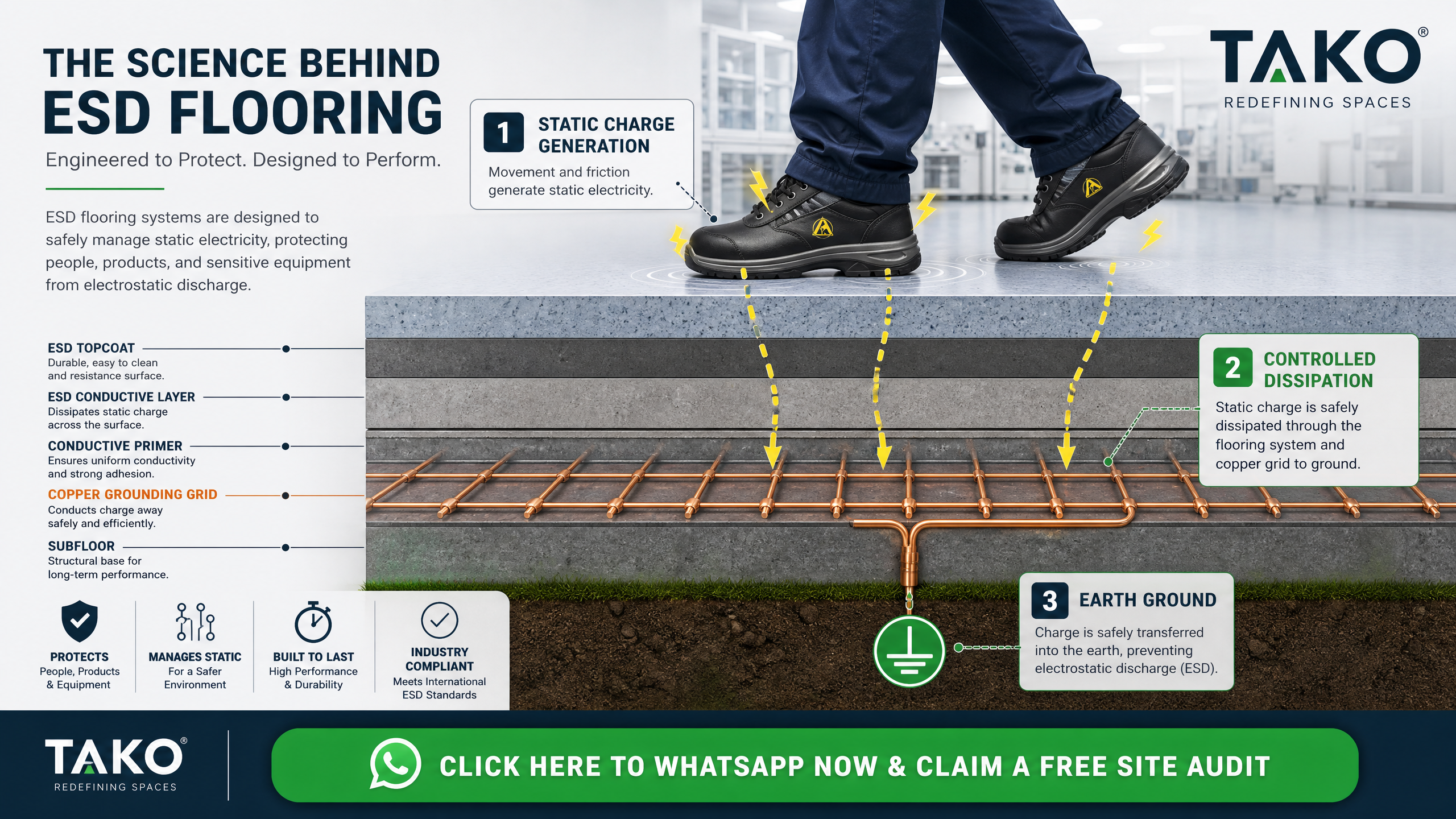
Understanding the fundamental principles of static electricity is crucial to appreciating the role of Anti-static Flooring Installation Kuala Lumpur. Electrostatic discharge occurs when two materials come into contact and then separate, causing a transfer of electrons. One material becomes positively charged, and the other negatively charged. When these charged materials come near a conductor, a sudden discharge of electricity can occur, damaging sensitive electronic components.
ESD flooring works by providing a controlled path for these charges to dissipate safely to the ground. Unlike insulative materials that block charge flow, or conductive materials that allow very rapid, uncontrolled discharge, ESD floors are typically static dissipative. This means they allow charges to flow at a controlled rate, preventing both rapid discharge and charge accumulation. This controlled dissipation is achieved through specialized materials and a grounding system that connects the floor to the building’s electrical ground.
7. Types of ESD Flooring Materials: A Comparative Look
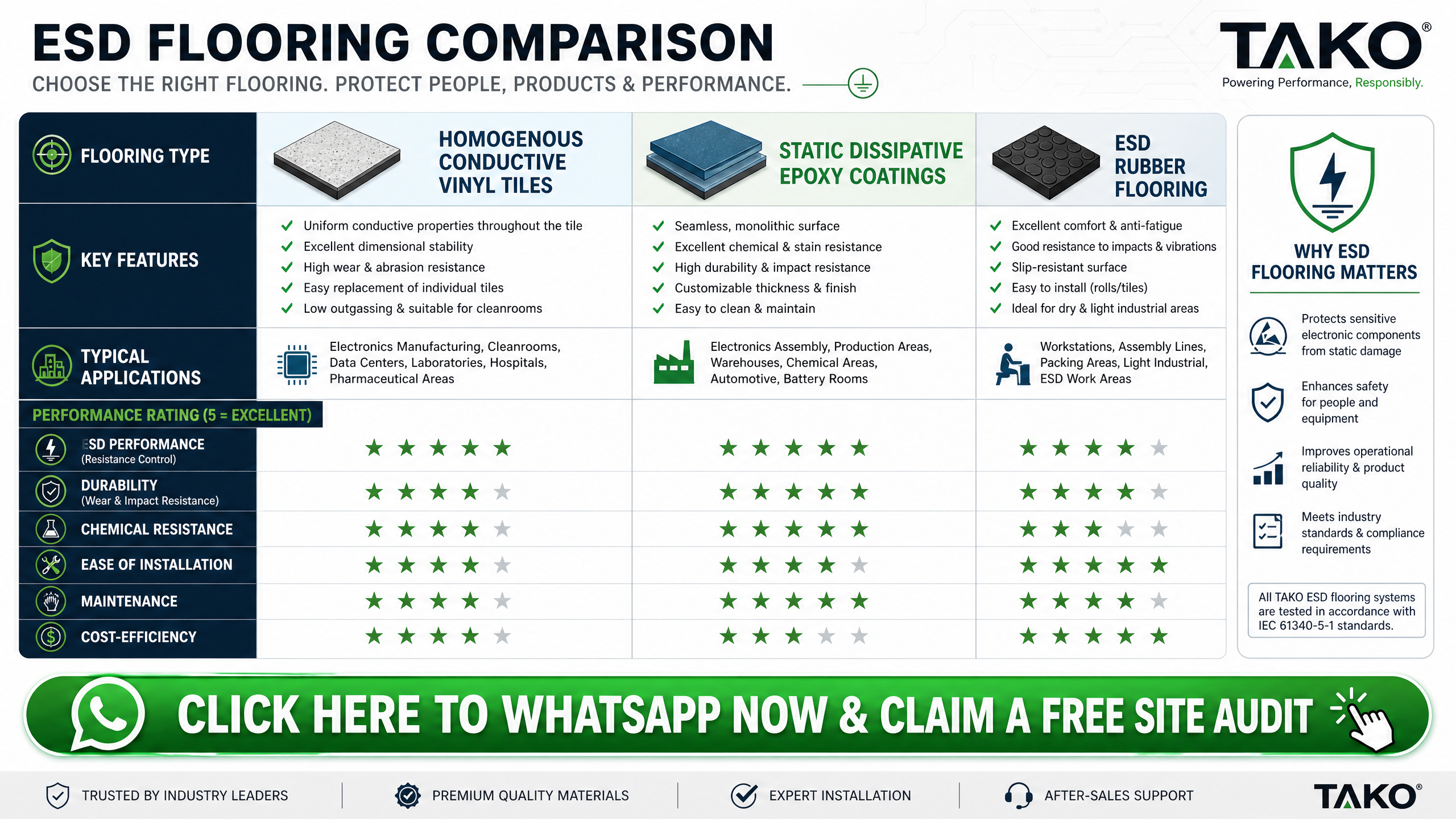
Choosing the right material is a critical decision for any Anti-static Flooring Installation Kuala Lumpur project. Different materials offer varying levels of performance, durability, and cost-effectiveness. TAKO offers a range of solutions tailored to specific industrial needs:
- Homogenous Conductive Vinyl Tiles: These are the most common and reliable choice for cleanrooms and electronics manufacturing. They offer consistent electrical properties throughout their thickness, making them highly durable and long-lasting. Their seamless installation with hot-air welding ensures a continuous ESD-safe surface.
- Static Dissipative Epoxy Coatings: Ideal for areas requiring a seamless, chemical-resistant, and highly durable surface, such as heavy-duty industrial zones or chemical processing plants. While effective, they require careful application and can be more challenging to repair than tiles.
- ESD Rubber Flooring: Often used in specialized environments like laboratories or control rooms where comfort and acoustic properties are also important. ESD rubber provides excellent static control and is highly resilient.
Each material has its advantages, and TAKO’s experts can guide you in selecting the optimal solution for your specific operational requirements and budget in Malaysia. For more details on our product range, visit our ESD Flooring Products page
8. Long-Term Maintenance and Re-certification: Sustaining Compliance
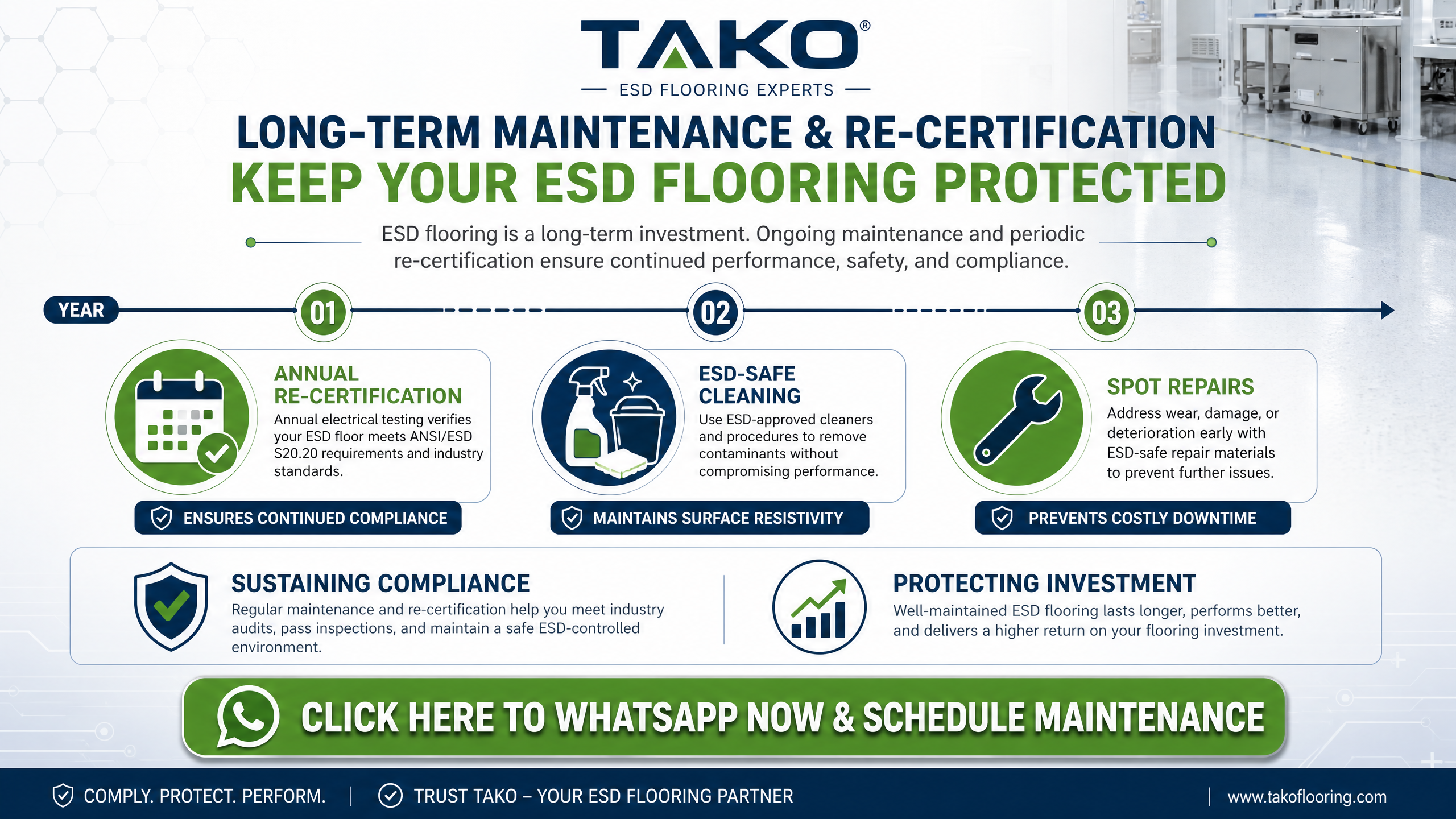
An Anti-static Flooring Installation Kuala Lumpur is not a one-time solution; it requires ongoing maintenance and periodic re-certification to ensure sustained compliance. Neglecting these aspects can lead to a gradual degradation of the floor’s ESD properties, putting your sensitive components at risk.
- Proper Cleaning Protocols: Regular cleaning with ESD-safe detergents is crucial. Standard cleaning agents can leave insulative residues that compromise the floor’s conductivity. TAKO provides comprehensive training on proper maintenance procedures.
- Periodic Testing: We recommend annual re-certification to verify that the floor continues to meet ANSI/ESD S20.20 and IEC 61340-5-1 standards. This involves re-measuring surface resistance, resistance to ground, and body voltage generation.
- Repair and Replacement: Over time, heavy traffic or accidental damage can affect localized areas. Prompt repair using compatible ESD materials is essential to maintain the integrity of the entire system.
TAKO offers tailored maintenance contracts and re-certification services across Malaysia, ensuring your investment in Anti-static Flooring Installation Kuala Lumpur continues to protect your assets for years to come. Learn more about our Maintenance Services (hypothetical internal link).
9. Case Study: Enhancing Production Yield in a Penang Semiconductor Plant

Consider a leading semiconductor manufacturer in Bayan Lepas, Penang, struggling with unexplained component failures during their final assembly stage. Despite having an existing “anti-static” floor, their audit revealed inconsistent ESD properties and high body voltage readings from operators.
TAKO was engaged for a comprehensive Anti-static Flooring Installation Kuala Lumpur project, which included replacing their old flooring with TAKO’s homogenous conductive vinyl tiles and implementing a robust grounding system. Post-installation, the plant reported a 15% reduction in component failure rates within six months, directly attributable to the improved static control. This led to significant cost savings and enhanced product reliability, solidifying their reputation as a top-tier supplier.
10. Environmental Factors Affecting ESD Performance
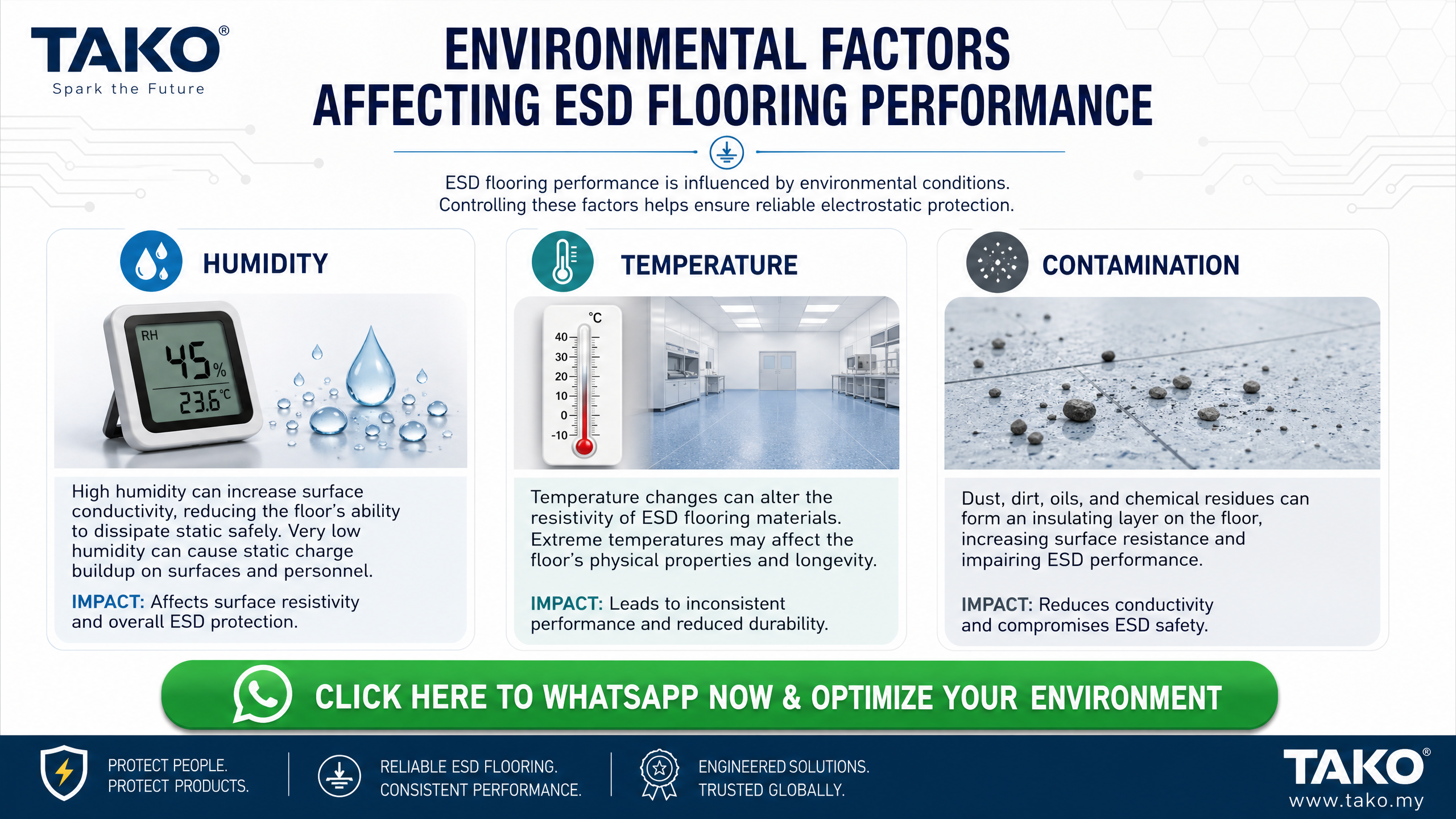
While ESD flooring is designed for robust performance, environmental factors can influence its effectiveness. Understanding these factors is key to maintaining optimal static control in your facility, especially in the diverse climate of Malaysia.
- Humidity: Low humidity can increase the generation and retention of static charges, making ESD control more challenging. While TAKO’s floors are designed to perform well across a range of humidity levels, maintaining controlled humidity in critical areas is always recommended. For more information on humidity control in cleanrooms, refer to this article on Cleanroom Technology [3].
- Temperature: Extreme temperature fluctuations can affect the physical properties of flooring materials and adhesives. Our installation process accounts for these variations to ensure long-term stability.
- Contamination: Dust, dirt, and non-ESD cleaning residues can create insulative layers on the floor surface, hindering its static dissipative properties. Strict adherence to cleaning protocols is paramount.
TAKO’s solutions for Anti-static Flooring Installation Kuala Lumpur are engineered to withstand these environmental challenges, providing reliable ESD protection even in demanding Malaysian industrial settings.
11. Installation Pitfalls to Avoid
Even the best ESD tiles will fail if installed incorrectly. Here is what we see most often in Malaysian factories:
- Poor Substrate Prep: Skipping the moisture test leads to bubbling and peeling.
- Non-Conductive Adhesive: Using the wrong glue acts as an insulator, rendering the ESD tiles useless.
- Incomplete Grounding: If the copper grid isn’t properly connected to the building’s main earth, the static has nowhere to go.
- Ignoring Communication Lines: ESD can also travel through data cables. A comprehensive solution includes protecting all entry points.
- Lack of Operator Training: Even with a perfect floor, operators must be trained on proper ESD protocols, including wearing appropriate footwear and grounding straps. You can find more resources on ESD training from the ESD Association
12. Conclusion: Securing the Future of Malaysian Electronics
As we move toward Industry 4.0 and more sensitive nanotechnology, the requirement for “clean” electrical environments is only increasing. Investing in Anti-static Flooring Installation Kuala Lumpur is a hallmark of a mature, well-managed industrial operation.
Whether you are running a small PCB shop in Klang or managing a massive semiconductor floor in Johor, the question isn’t if an ESD event will occur, but when. Be ready.
Expert Consultation: Take the Next Step
Don’t wait for an audit failure to force your hand. Protect your yield today.
Are you ready to audit your facility’s static control? Our team specializes in industrial-grade Anti-static Flooring Installation Kuala Lumpur tailored for the Malaysian climate and industrial standards.
[CLICK HERE TO WHATSAPP NOW & CLAIM A FREE SITE AUDIT FOR ESD FLOORING SOLUTIONS]
Frequently Asked Questions (FAQ)
Can I just use anti-static wax on my existing floor?
Absolutely not. Anti-static wax is a temporary topical treatment. It does not provide a reliable path to ground and wears off quickly in industrial environments. Anti-static Flooring Installation Kuala Lumpur provides a permanent solution.
How often should I test my ESD floor?
We recommend a professional re-certification every 12 months to ensure continued compliance with ANSI/ESD S20.20.
Does ESD flooring require special cleaning?
Yes. You must use ESD-safe cleaners that do not leave an insulating residue. TAKO provides full maintenance training as part of our installation service.
References
[1] IEC 61340-5-1. Electrostatics – Part 5-1: Protection of electronic devices from electrostatic phenomena – General requirements. https://www.iec.ch/
[2] ANSI/ESD S20.20. Standard for the Development of an Electrostatic Discharge Control Program for Protection of Electrical and Electronic Parts, Assemblies, and Equipment (Excluding Electrically Initiated Explosive Devices). https://www.esda.org/
[3] Cleanroom Technology. Humidity control in cleanrooms. https://www.cleanroom-technology.com/news/article_page/Humidity_control_in_cleanrooms/169006
[4] ESD Association. ESD Training. https://www.esda.org/esd-training/
Disclaimer
The information provided in this blog is intended for general informational purposes only. Prices, specifications, and availability may vary depending on suppliers, location, and market conditions. Readers should verify details directly with suppliers or manufacturers before making purchasing decisions. The author and website are not responsible for any errors, omissions, or outcomes resulting from the use of this information. Always consult a professional for advice tailored to your specific needs.


