
TAKO Since 1979: Prevent Equipment Failure with Electronic Static Protection Flooring

1. Introduction: The Hidden Cost of Static Discharge
Electronic Static Protection Flooring is the thin line between a high-functioning facility and a multi-million dollar disaster. In the high-stakes world of modern manufacturing and data management, a single spark—one so microscopic it cannot even be felt by a human being—can result in catastrophic equipment failure and staggering financial losses. This is the “Invisible Enemy” known as Electrostatic Discharge (ESD). As technology evolves and components shrink to nanometer scales, they become increasingly vulnerable, shifting the need for robust Electronic Static Protection Flooring from a secondary luxury to a mandatory, fundamental infrastructure requirement.
TAKO Since 1979 has been the definitive authority at the forefront of this battle. With over four decades of battle-tested specialized experience, we have witnessed the evolution of high-tech environments firsthand. We understand that in 2026, facility managers are no longer just looking for a surface to walk on; they are looking for a performance-guaranteed, high-integrity shield. Electronic Static Protection Flooring acts as that primary defense system, ensuring that every technician, visitor, and piece of precision equipment entering your sensitive zone is instantly and safely grounded, eliminating the threat before it strikes.
Table of Contents
2. What is Electronic Static Protection Flooring?
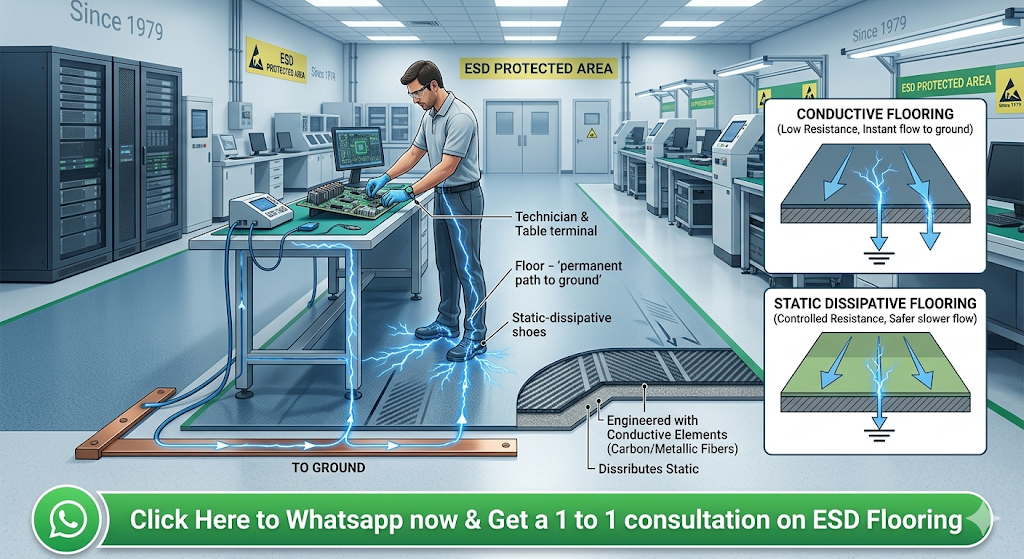
To understand why Electronic Static Protection Flooring is essential, one must understand its composition. Unlike standard flooring, which can act as an insulator and allow static to build up on moving personnel, this specialized flooring is engineered with conductive elements—typically carbon or metallic fibers—distributed throughout the material.
There are two primary categories you will encounter:
- Conductive Flooring: This has a lower electrical resistance, allowing static to flow to the ground almost instantly.
- Static Dissipative Flooring: This has a slightly higher resistance, controlling the flow of static at a slower, safer rate to prevent accidental high-voltage surges.
When you install Electronic Static Protection Flooring, you are creating a permanent path to the ground. This path ensures that the “triboelectric charging” (the static generated by walking or moving equipment) is neutralized before it can discharge into a sensitive PCB or server rack.
3. How Static Electricity Causes Equipment Failure
To understand why Electronic Static Protection Flooring has become the non-negotiable benchmark for modern industry, we have to look at the physics of how static interacts with micro-circuitry. When we talk about “catastrophic alternatives,” we are referring to the specific ways uncontrolled electricity interacts with silicon and data.
Here is a deeper breakdown of those three primary impact points:
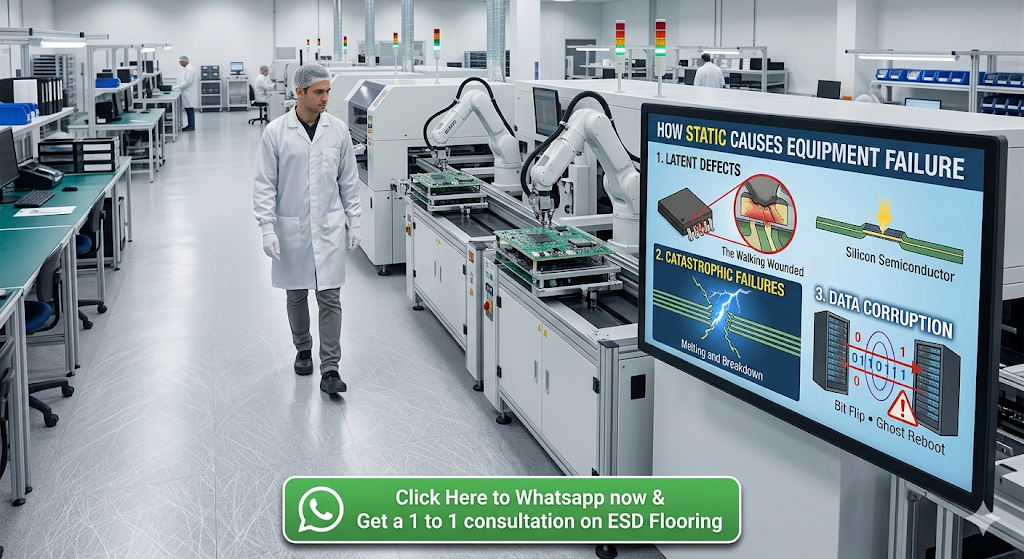
1. The Deceptive Danger of Latent Defects
Latent defects are often called “time bombs.” In a facility without Electronic Static Protection Flooring, a technician might touch a circuit board and feel nothing. However, that microscopic discharge can create a “gate leakage” or a partial melt in a semiconductor’s internal wiring.
- The “Walking Wounded” Effect: The component still works during the factory Burn-In test and Quality Assurance check.
- The Field Failure: Once the product is in the customer’s hands, the weakened area is stressed by normal operating heat and eventually snaps.
- The Consequence: This leads to high warranty claim costs and, more importantly, a loss of trust in your brand’s reliability. Electronic Static Protection Flooring prevents these “near-misses” from ever occurring by draining the charge before the touch happens.
2. The Financial Shock of Catastrophic Failures
Unlike latent defects, catastrophic failures are immediate. This is where the voltage is high enough to cause “junction punch-through” or metalization melt.
- Physical Destruction: At a microscopic level, a static discharge is like a lightning bolt hitting a city. It literally melts the traces on a silicon chip.
- Production Bottlenecks: If a key component fails during the assembly of a high-value asset (like an aircraft control system or a medical imaging device), the entire line stops.
- Scrap Costs: In high-volume manufacturing, a lack of Electronic Static Protection Flooring can lead to “yield loss,” where a significant percentage of every batch is tossed in the bin.
3. Data Corruption and Signal Integrity
In the age of Big Data and AI, the threat of static has moved beyond just “breaking” things; it now “confuses” them. In server environments, the magnetic fields generated by an ESD event can be devastating.
- Bit Flipping: A discharge near a storage drive or high-speed data bus can cause a “0” to become a “1.” This is data corruption at the most fundamental level.
- System Reboots: Static can trigger a reset in sensitive controllers, leading to unexplained “ghost” reboots in data centers.
- EMI Interference: Electronic Static Protection Flooring doesn’t just ground people; it helps stabilize the Electromagnetic Interference (EMI) environment of the room. By keeping the floor at a neutral potential, you reduce the background “noise” that can interfere with high-speed communication cables.
4. Key Benefits of the TAKO Solution
1. Unmatched Durability: Built for the Modern Factory
Modern manufacturing environments are no longer just about foot traffic; they are high-stress zones for flooring. Electronic Static Protection Flooring must be able to handle extreme mechanical loads without compromising its electrical integrity.
- AGV and Robot Compatibility: Automated Guided Vehicles (AGVs) exert constant, repetitive pressure on specific paths. Low-quality flooring often cracks or delaminates under this stress, breaking the conductive path. TAKO Since 1979 ensures that the flooring material is homogenous or reinforced to withstand heavy-duty rolling loads.
- Dimensional Stability: In climates with high humidity or temperature fluctuations, inferior floors may expand or contract. Our Electronic Static Protection Flooring is engineered to remain flush, preventing “tripping hazards” for sensitive robotic sensors and maintaining a constant connection to the grounding grid.
2. Life-Cycle Consistency: Stability That Doesn’t Fade
The biggest risk with “budget” ESD solutions is electrical drift. Many anti-static coatings or low-grade tiles rely on top-tier chemicals that eventually wash away or wear down, turning your Electronic Static Protection Flooring into a standard, insulating floor without you even noticing.
- Permanent Conductivity: We utilize carbon-black or high-grade conductive particles that are integrated throughout the entire thickness of the material. This means that as the floor wears down over 10 or 15 years, the resistance level remains exactly the same as the day it was installed.
- Resistance to “Insulative Build-up”: Some materials attract dirt or waxes that “clog” the conductive pathways. Electronic Static Protection Flooring from TAKO is designed with a high-density surface that resists contaminant penetration, ensuring your readings stay consistent year after year.
3. Safety First: Preventing the Spark of Disaster
While equipment protection is about ROI, human safety is about lives. In many sectors, Electronic Static Protection Flooring is the primary line of defense against workplace explosions and fire.
- Explosive Atmosphere (ATEX) Compliance: In pharmaceutical labs, munitions plants, or chemical processing zones, airborne powders or volatile gases are common. A single static discharge from a person walking across the room can act as an ignition source.
- The “Human Grounding” Essential: Our Electronic Static Protection Flooring ensures that the human body—which can easily carry a charge of over 5,000 volts—is constantly drained to 0 volts. This eliminates the “zap” that could trigger a secondary disaster.
- Employee Comfort and Health: Beyond sparks, chronic exposure to micro-shocks can cause muscle fatigue and discomfort. By creating a neutral electrical environment, TAKO Since 1979 helps foster a safer and more comfortable workplace for your most valuable asset: your people.
5. Industry Standards & Compliance
In the world of industrial compliance, “close enough” is not good enough. Your Electronic Static Protection Flooring must meet rigorous international standards to be considered effective.
The primary standard we adhere to is ANSI/ESD S20.20. This standard requires that the floor-person-footwear system maintains a resistance of less than $1 \times 10^9$ ohms. When we install Electronic Static Protection Flooring, we provide the certification and testing data required to prove your facility is compliant during audits. We also look at IEC 61340-5-1, ensuring that your global operations meet a unified safety benchmark.
6. Applications: Where ESD Protection is Non-Negotiable
In high-tech industries, Electronic Static Protection Flooring isn’t just a floor covering; it’s a mission-critical component of the production environment. When failure is not an option, the precision of your grounding system becomes the backbone of your operational integrity.
Here is a detailed look at why Electronic Static Protection Flooring is non-negotiable in these specific sectors:
1. Semiconductor Fabrication: Guarding the Nanoscale
In the world of microchip manufacturing, we are dealing with transistors that are only a few atoms wide. At this scale, even a discharge of 10 to 20 volts—far below what a human can feel—is like a lightning bolt hitting a skyscraper.
- Yield Protection: Without Electronic Static Protection Flooring, “yield loss” (the percentage of chips that must be thrown away) can skyrocket.
- Contamination Control: Static electricity attracts dust and airborne particles to sensitive silicon wafers. By maintaining a neutral floor, you also assist the cleanroom’s air filtration systems in keeping the environment pristine.
- Legacy Quality: TAKO Since 1979 has provided flooring for some of the world’s most advanced cleanrooms, ensuring that the electrical resistance remains uniform across every square meter of the fab.
2. Aerospace & Defense: National Security Reliability
When a component is destined for a satellite, a fighter jet, or a missile guidance system, there is zero room for a “latent defect.” If a part fails in orbit or mid-flight, it cannot be easily repaired.
- Mission Success: Electronic Static Protection Flooring ensures that the sophisticated sensors and communication arrays are never compromised during assembly.
- Standard Compliance: Defense contractors must meet strict military-grade ESD standards (such as MIL-STD-1686). Our flooring provides the documented proof of compliance required for high-level government audits.
- Extreme Precision: For radar and navigation equipment, even minor signal “noise” caused by static can lead to calibration errors.
3. Healthcare Imaging: Ensuring Diagnostic Accuracy
Modern medical diagnostics rely on incredibly faint signals to create images of the human body. MRI, CT, and PET scanners are highly sensitive to electromagnetic interference (EMI).
- Signal Integrity: A static discharge in an imaging suite can create “artifacts” or blips on a scan, potentially leading to a misdiagnosis. Electronic Static Protection Flooring keeps the ambient electrical environment quiet and stable.
- Patient Safety: High-voltage medical equipment requires a perfectly grounded environment to prevent leakage currents from reaching patients or healthcare providers.
- Hygiene + Protection: Our flooring solutions for healthcare combine antimicrobial properties with permanent conductivity, satisfying both medical hygiene and electrical safety codes.
4. Automotive Electronics & EV Manufacturing
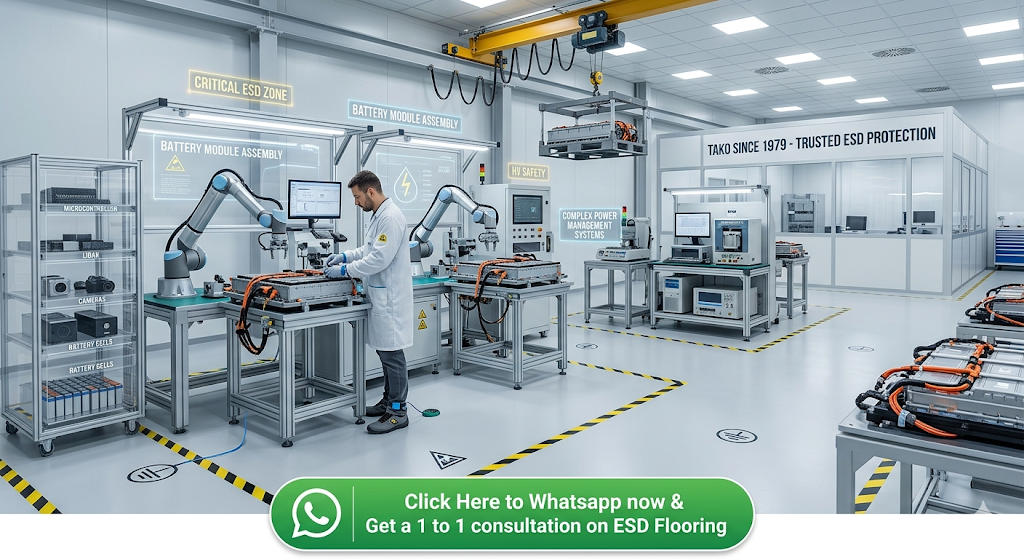
As vehicles transition into “computers on wheels,” the automotive assembly line has changed. The rise of Electric Vehicles (EVs) has introduced high-voltage battery packs and complex Power Management Systems that are highly sensitive to ESD.
- Battery Safety: During the assembly of lithium-ion battery modules, a stray spark can lead to a thermal runaway event. Electronic Static Protection Flooring is a primary safety requirement in battery gigafactories.
- Advanced Driver Assistance Systems (ADAS): The cameras, LiDAR, and radar units that enable self-driving features are susceptible to the same latent defects found in high-end consumer electronics.
- The TAKO Advantage: As EV manufacturers scale globally, they rely on TAKO Since 1979 to provide a consistent flooring standard across international production sites, ensuring that a car built in Asia has the same ESD safeguards as one built in Europe.
7. Maintenance Tips for Long-Term Protection
Maintaining an Electronic Static Protection Flooring system is not just about aesthetics; it is about preserving the life-saving and equipment-protecting electrical properties of the material. Think of your floor as a functional electronic component—if you don’t maintain the circuit, the system fails.
Here is a deep dive into why these maintenance protocols are the difference between a safe facility and a high-risk zone:
1. The Danger of “Insulative Film” (The Wax Trap)
The most frequent cause of Electronic Static Protection Flooring failure is the application of incorrect cleaning agents or standard commercial waxes.
- The Science of the Failure: Standard floor waxes are designed to be non-conductive (insulators). When you apply them, they create a clear, plastic-like barrier between the soles of a technician’s shoes and the conductive elements of the floor.
- “Turning Off” the Floor: Even if the floor underneath is perfect, this microscopic layer of wax prevents the static charge on a person’s body from reaching the grounding path. To a surface resistance meter, your expensive Electronic Static Protection Flooring will now read like a standard, dangerous plastic floor.
- The TAKO Solution: We recommend only specialized ESD-safe finishes that contain surfactants designed to enhance, rather than hinder, the dissipative qualities of the surface.
2. Gentle Cleaning: Preserving the Conductive Matrix
Because Electronic Static Protection Flooring relies on a specific network of conductive particles (like carbon or graphite), the physical integrity of the surface is paramount.
- Avoid Abrasives: Using harsh chemicals or heavy-duty abrasive pads can physically “strip” the conductive veins from the top layer of the floor. Once these pathways are broken, the static has nowhere to go.
- pH Neutrality: Many industrial cleaners are highly acidic or alkaline, which can chemically degrade the polymers holding the conductive particles in place. TAKO Since 1979 advises using pH-neutral, ESD-specific detergents that lift dirt without attacking the floor’s chemistry.
3. Resistance to Ground (RTG) Testing: Verification is Key
You cannot see, smell, or hear static protection—you can only measure it. Regular testing is the only way to ensure your Electronic Static Protection Flooring is still doing its job.
- The RTG Test: This involves placing a calibrated weight (electrode) on the floor and measuring the resistance between that point and the facility’s electrical ground.
- Audit Compliance: For industries following ANSI/ESD S20.20, these tests must be logged. If a “dead spot” is found where the floor is no longer conductive, it must be addressed immediately to prevent equipment failure.
- Frequency: High-traffic areas should be tested monthly, while low-traffic zones can be audited quarterly. This proactive approach ensures that your investment in Electronic Static Protection Flooring remains a reliable shield for decades.
4. Environmental Control: The Humidity Factor
While not strictly a “cleaning” step, maintaining the environment is part of floor maintenance.
- Moisture Matters: Very low humidity can increase static generation. Even the best Electronic Static Protection Flooring performs better when the relative humidity is kept between 30% and 60%.
- Contamination Control: Dust is an insulator. Regular damp-mopping with ESD-safe solutions ensures that a layer of dust doesn’t build up and act as a barrier to the grounding process.
8. Conclusion: Investing in Reliability
When you evaluate the cost of Electronic Static Protection Flooring, do not look at it as a construction expense. Look at it as an insurance policy for your technology. Since 1979, TAKO has helped thousands of companies eliminate the risk of ESD-related downtime. By choosing a high-quality Electronic Static Protection Flooring, you are choosing a future of fewer defects, higher yields, and total peace of mind.
9. Disclaimer
The information provided in this article regarding Electronic Static Protection Flooring is for educational purposes only. While Electronic Static Protection Flooring is a critical component of an ESD Protected Area (EPA), it must be integrated with proper footwear, wrist straps, and humidity controls to be fully effective. TAKO Since 1979 is not liable for failures resulting from improper third-party installations or site-specific variables beyond our control. Always consult with an ESD certified professional before finalizing your facility layout.
10. Frequently Asked Questions (FAQ)
How long does Electronic Static Protection Flooring last?
When properly maintained, a high-quality Electronic Static Protection Flooring system can last 15 to 20 years without losing its conductive properties.
Can I install Electronic Static Protection Flooring over my existing subfloor?
Yes, provided the subfloor is level, dry, and free of cracks. A conductive primer is often used to ensure the Electronic Static Protection Flooring bonds correctly to the grounding copper strips.
Does Electronic Static Protection Flooring require special waxes?
Absolutely. Never use standard commercial wax. Only use specialized ESD floor finishes that maintain the surface resistance of your Electronic Static Protection Flooring.
Is Electronic Static Protection Flooring expensive compared to standard vinyl?
The initial investment is higher, but when you factor in the cost of one ruined server or a week of production downtime, Electronic Static Protection Flooring pays for itself within the first year.


